


Depression in men is common
If you picture depression, you probably picture sadness: tears, a heavy heart, someone who can’t get out of bed. For many men, that picture simply doesn’t match what’s happening inside them. And because it doesn’t match, they miss it. So do their partners, friends, doctors, and sometimes even therapists.
Here’s what I want you to take from this post: depression in men is common, it often looks like something else, and it is very treatable. If you’re a man reading this, I hope you’ll recognize yourself without judgment. If you love a man, I hope you’ll find some new ways to understand what you’ve been seeing.
Many of us grew up with unwritten rules about what men are supposed to feel and show. Be strong. Handle it. Don’t complain. Those messages run deep, and they shape how distress gets expressed. When sadness feels off-limits, it doesn’t disappear. It goes looking for another way out.
It doesn’t always look like sadness
When men are depressed, the signs are often more about doing and feeling in the body than about openly feeling low. Some of the most common ones I see:
- Irritability and anger. A short fuse, snapping over small things, road rage, a constant sense of being on edge. Anger is often the only emotion that feels acceptable, so it carries everything else.
- Withdrawal. Pulling back from friends, skipping the things he used to enjoy, going quiet at home. From the outside, it can look like he just doesn’t care anymore. Inside, it’s often exhaustion and shame.
- Numbness. Not feeling sad, exactly, but not feeling much of anything. Food, hobbies, even people he loves can feel flat.
- Restlessness and overworking. Staying busy so there’s no room to feel. Longer hours, more projects, never quite switching off.
- Physical complaints. Headaches, stomach trouble, aches without a clear cause, trouble sleeping, or sleeping far too much. Fatigue that rest doesn’t fix.
- Difficulty concentrating and making decisions, or a creeping sense of failure and being “not enough” that he rarely says out loud.
- Risk-taking. Reckless driving, gambling, or impulsive choices that are out of character.
None of these automatically means depression. But when several show up together, last for weeks, and don’t feel like “just stress,” it’s worth taking seriously.
When coping becomes self-medication
If you can’t name what hurts, you’ll reach for whatever makes it quieter. That’s what self-medication is: using something to take the edge off feelings you don’t know how, or don’t feel allowed, to deal with.
For many men, that means alcohol, cannabis, or other substances. But it isn’t only substances. It can look like endless gaming or scrolling, working all hours, gambling, pornography, or throwing yourself into the gym to the point of exhaustion. Plenty of these things are fine in moderation. The question is what job they’re doing. If a drink, a screen, or a workout is the only way you ever settle down or switch off, it may be doing the job of an emotion you haven’t had room to feel.
The trouble is that self-medication works, a little, for a while. That’s what makes it so hard to spot. Over time, though, it tends to deepen the very thing it was meant to soothe: sleep gets worse, mood drops, relationships strain, and shame builds. And because the substance or habit becomes the visible problem, the depression underneath can go unnoticed for years.
If you recognize this pattern, you’re not weak or broken. You found a way to cope with something heavy, with the tools you had. Therapy is about finding better ones.
Self-harm and thoughts of suicide
This is the hardest part to write about, and the most important. In Canada, men die by suicide at a much higher rate than women, even though women are diagnosed with depression more often. Part of the reason is that men’s depression so often goes unrecognized and untreated, and part is that many men don’t tell anyone how bad it has become.
Self-harm in men doesn’t always look the way people expect. Sometimes it’s deliberate, like hurting yourself to release pressure or feel something. Sometimes it’s quieter and indirect: reckless behaviour, ignoring your health, drinking or using in ways that put you at risk, or not caring whether you’re careful. These can be signs that someone is in real pain, even when no one calls it that.
Thoughts like “everyone would be better off without me” or “I just want this to stop” are not signs of weakness or selfishness. They are signals that the pain has outgrown what a person can carry alone. They are also far more common than most people realize, and they can change with support.
Some signs to take seriously in yourself or someone you love:
- Talking about being a burden, feeling trapped, or having no way out
- Giving away possessions or suddenly putting affairs in order
- A sudden, unexplained calm after a long dark stretch
- Increased drinking or substance use alongside hopelessness
- Saying goodbye in ways that feel unusual
If you are having thoughts of suicide or self-harm, please reach out today. In Canada, you can call or text 9-8-8, the Suicide Crisis Helpline, any time, day or night. If you or someone you know is in immediate danger, call 911. You don’t have to be at the edge of a crisis to deserve support, and you don’t have to figure out the right words first.
If you’re worried about someone else, ask them directly. Asking “Are you thinking about suicide?” does not plant the idea. More often, it’s a relief to be asked. Then listen, stay with them, and help them connect with support.
How it shows up in relationships
Depression rarely stays in one person. It moves through a household, and it often gets misread along the way.
A partner might see a man who’s distant, short-tempered, or no longer interested in intimacy, and conclude, “He doesn’t love me anymore,” or “I’m the problem.” The man, meanwhile, may feel like a failure, withdraw further to protect everyone from his mood, and say less and less. Both people end up lonely in the same room. Over time, that cycle of pursuit and withdrawal can wear down even strong partnerships.
Friendships take a hit too. Many men maintain friendships around activities (sports, projects, a beer on Friday) rather than around talking about what’s going on inside. When depression makes the activities feel like too much, the connection can quietly fade, right when it’s needed most.
If you’re the partner, a few things can help:
- Name what you see, without blame. “I’ve noticed you’ve seemed worn out and on edge lately. I’m not mad; I’m worried.”
- Don’t take the withdrawal personally. It’s usually about him, not about you.
- Look after yourself too. Living with someone who’s struggling is draining, and you need support of your own.
- Invite, don’t push. Suggesting a conversation with a doctor or therapist lands better as “I want us to feel better” than “something is wrong with you.”
And if you’re the one struggling, letting someone in, even a little, is often the first thing that starts to loosen depression’s grip. You don’t have to explain it perfectly. “I’m not doing great, and I don’t totally know why” is enough to begin.
What it means for fathers and their kids
Most dads who are depressed are still showing up. They’re going to work, driving to practice, making dinner. What’s harder to hide is the emotional availability that kids need: patience, play, warmth, and a sense that Dad is really there.
Children are remarkably tuned in. They may not know the word “depression,” but they notice the shorter temper, the quiet evenings, the dad who’s present but somewhere else. Younger kids often assume it’s their fault. Teens may pull away, act out, or start to mirror the same silence. Without an explanation, kids fill in the gaps with their own stories, and those stories are usually harsher than the truth.
Here’s the hopeful part: children don’t need a perfect parent, and they don’t need a parent who never struggles. They need a parent who is honest at their level, who repairs after a hard moment, and who shows them what it looks like to get help.
A few ways that can look in everyday life:
- Repair quickly. “I snapped at you earlier, and that wasn’t about you. I’m sorry.” Repair teaches more than never making a mistake.
- Give a simple, age-appropriate explanation. “Dad’s been feeling really down and tired. It’s not your fault, and I’m working on feeling better.”
- Keep small rituals. A bedtime story, a walk, a Saturday pancake routine. Consistency matters more than grand gestures.
- Let them see you get support. A father who says “I’m talking to someone about this” gives his kids permission to do the same one day.
Getting help is not taking something away from your family. It’s one of the most protective things you can do for them.
What helps, and where to start
Depression is one of the most treatable mental health conditions, and men do get better. Therapy, sometimes alongside medication through a family doctor or psychiatrist, can make a real difference. So can movement, sleep, time with people you trust, and learning to name what you’re feeling instead of carrying it alone.
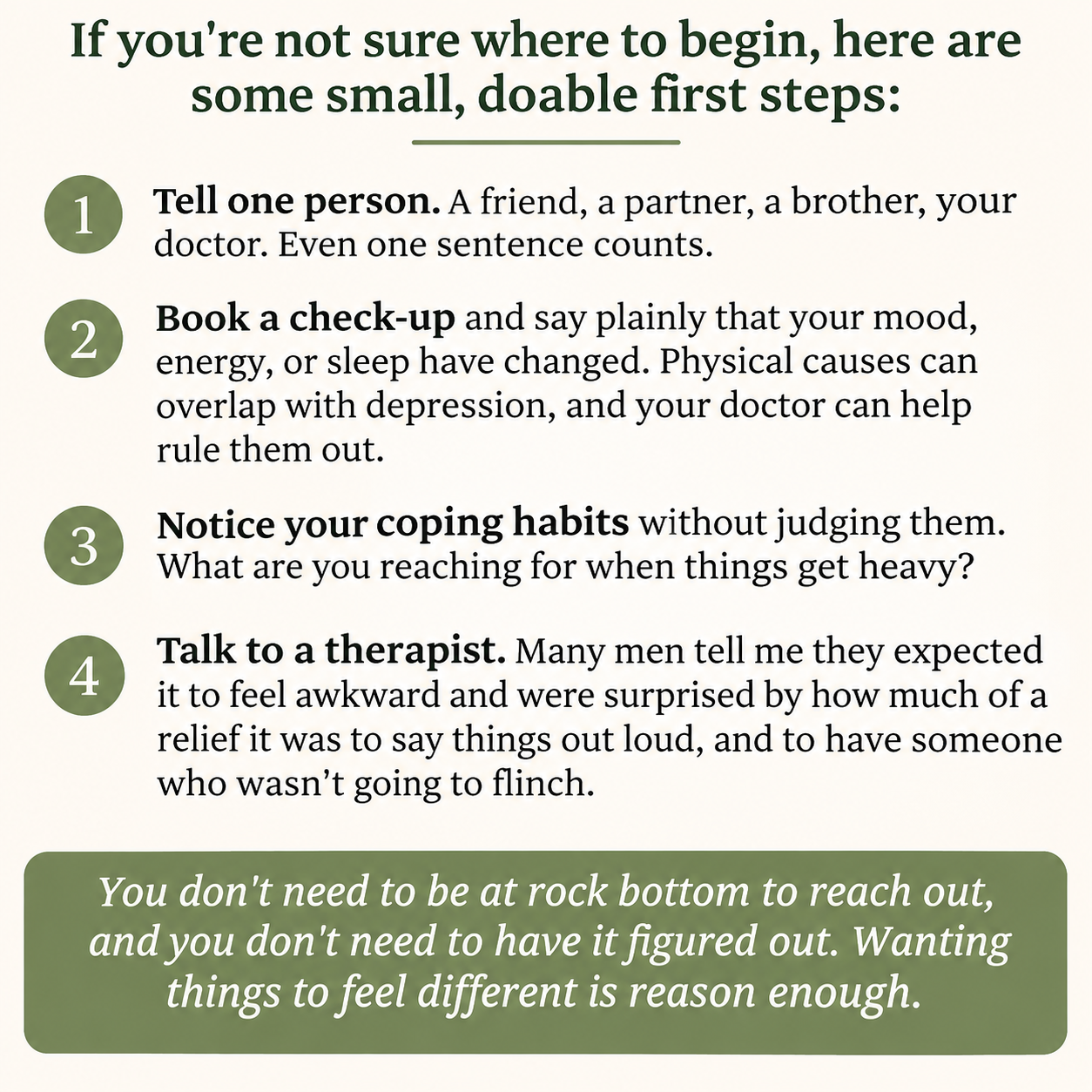
If you’re not sure where to begin, here are some small, doable first steps:
- Tell one person. A friend, a partner, a brother, your doctor. Even one sentence counts.
- Book a check-up and say plainly that your mood, energy, or sleep has changed. Physical causes can overlap with depression, and your doctor can help rule them out.
- Notice your coping habits without judging them. What are you reaching for when things get heavy?
- Talk to a therapist. Many men tell me they expected it to feel awkward and were surprised by how much of a relief it was to say things out loud, and to have someone who wasn’t going to flinch.
You don’t need to be at rock bottom to reach out, and you don’t need to have it figured out. Wanting things to feel different is reason enough.
If you’re in Ontario and you’d like to talk, we offer in-person sessions in Burlington and virtual sessions across the province, in English and Spanish. You can learn more or get in touch with us. And if you’re in crisis right now, please call or text 9-8-8.
This post is for general information and isn’t a substitute for professional mental health care.