


Trust builds in small bids
Trust is the quiet part of a relationship. When it’s there, you barely notice it. You simply relax into the person beside you, and when it wobbles, everything else gets louder.
Most of us start from a good place. In Statistics Canada’s 2023 Canadian Social Survey, 89% of Canadians reported a high level of trust in family members, and 70% in friends. That survey wasn’t about romantic partners specifically, but one finding is worth sitting with: people who were highly satisfied with their personal relationships were more than four times as likely to trust others highly (40% versus 9%).
Here’s the hopeful part. Trust isn’t a trait you either have or don’t. It’s built through small, repeated behaviours, and when it gets bruised, it can be repaired. Let’s look at how.
What trust is really made of
If you’ve ever tried to explain trust, you know it’s slippery. The Gottman Institute offers a surprisingly practical definition: the trust metric is your confidence that your partner has your best interests at heart. Gottman describes trust, along with commitment, as one of the two weight-bearing walls of the Sound Relationship House. You can have lovely communication skills and still feel shaky if that wall is cracked.
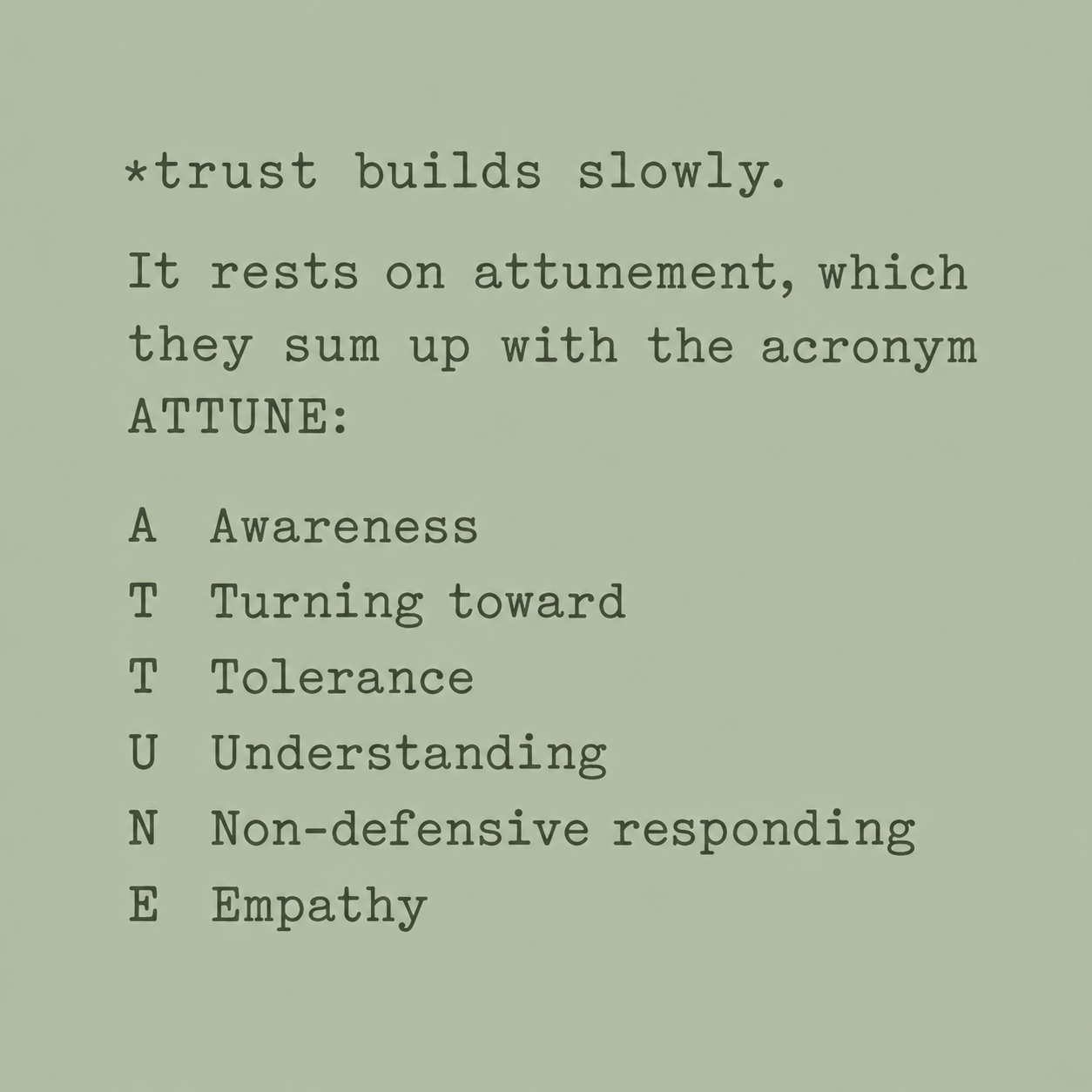
The Gottman team also stresses that trust builds slowly. It rests on attunement, which they sum up with the acronym ATTUNE: Awareness, Turning toward, Tolerance, Understanding, Non-defensive responding and Empathy. Notice that none of those is a grand gesture. They’re all ways of paying attention, again and again, across the seasons of a relationship.
That’s good news, because it means you don’t need a dramatic breakthrough. You need a handful of everyday habits.
Four everyday behaviours that build trust
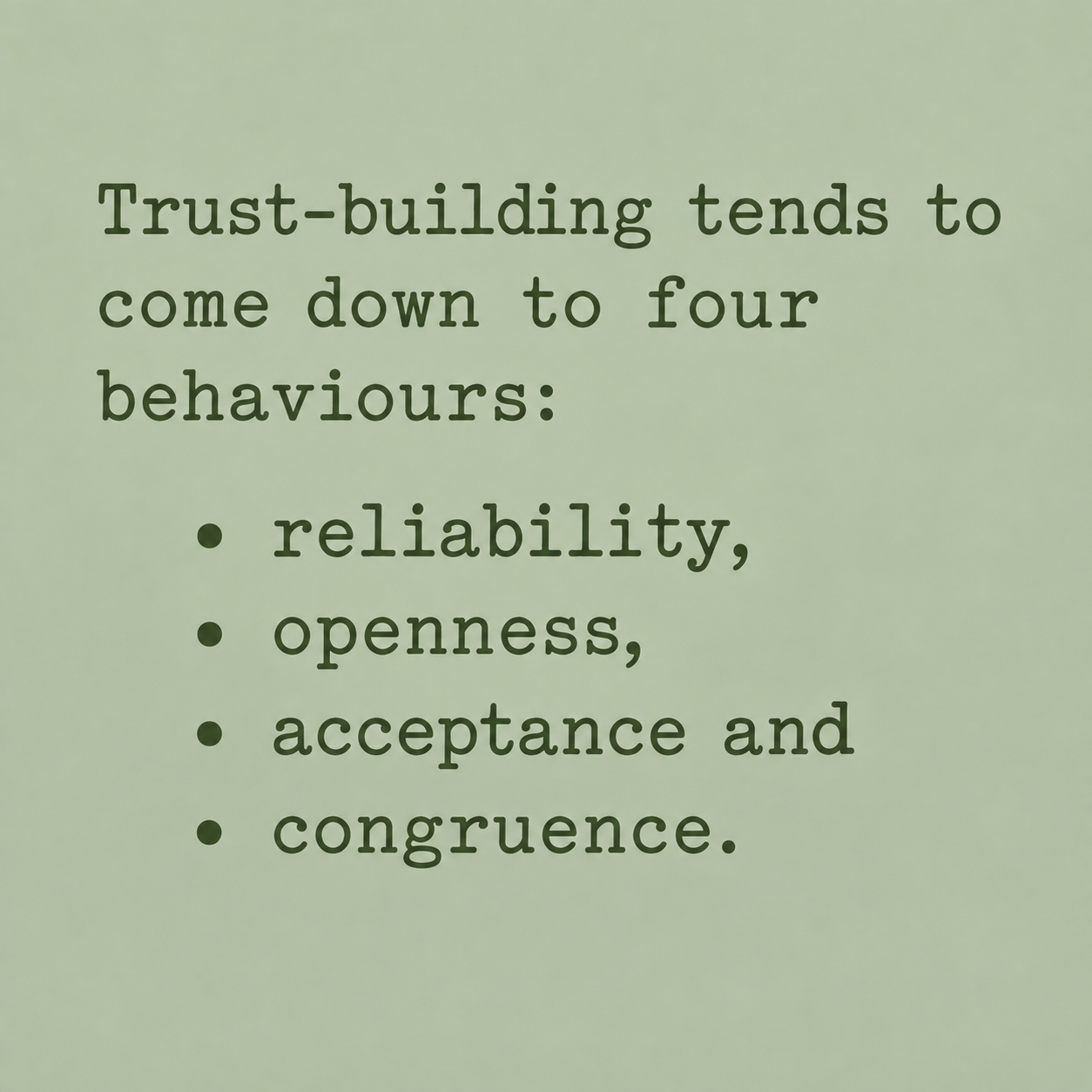
Trust-building tends to come down to four behaviours: reliability, openness, acceptance and congruence. None of them needs a therapist’s office to practise. The couples below are invented for illustration, and the ideas apply whatever shape your relationship agreements take, whether monogamous, open or somewhere in between.
Reliability: doing what you said you’d do
Reliability is the easiest one to understand and the easiest to underestimate. It’s the sum of a thousand small promises: I’ll call you at lunch, I’ll pick up the kids, I’ll be home by six. Each time you follow through, your partner learns that your word holds weight.
Picture Sam, who tells his partner Dana he’ll book the dentist this week. A week passes, then another. It isn’t a betrayal, exactly, but Dana quietly stops relying on him and starts doing it herself. That’s how reliability erodes: not with a bang, but with a shrug.
Writing for the Gottman Institute, therapist Brittini Carter offers refreshingly simple advice: say what you mean and mean what you say, and if plans change, tell your partner rather than letting it slide. A small promise you keep builds more trust than a big one you quietly drop. And if you’ve agreed on something together, like a check-in before a night out or a spending limit, reliability means honouring that agreement.
Try this: make one small promise this week and keep it. If you can’t, say so before the deadline, not after.
Openness: letting your partner see in
Openness means sharing what’s going on inside you and in your life: feelings, plans, worries, money. It also means being receptive when your partner does the same.
Money is where many Canadians tell on themselves. In a January 2025 TD survey, 70% of Canadians agreed that financial transparency matters in a relationship, and 71% said they’d consider breaking up with a partner who was dishonest about money. Yet only 41% of couples had the money talk when they moved in together or married.
A 2026 Money Mentors survey found that 11% of Canadians in relationships admitted lying to a partner about their finances to avoid conflict, up from 8% the year before. These are commissioned surveys rather than academic studies, so think of them as snapshots.
Imagine Maya, who has been carrying a credit card balance she hasn’t mentioned because she dreads the argument. The debt is manageable. The secret is what’s heavy. The Gottman Institute makes a similar point about lying to dodge a fight: the argument is postponed, but your partner is now making decisions without knowing the truth.
Try this: put a short, regular check-in on the calendar. In the TD survey, nearly half of Canadians felt that talking about money once or twice a month was ideal. Then add one more question: is there anything you’ve been holding back?
Acceptance: being safe to be yourself
Acceptance is feeling valued as you are, quirks and fears included. It isn’t agreeing about everything. It’s making it safe for your partner to be a whole person around you without being corrected, managed or quietly graded.
Gottman’s ATTUNE acronym already points this way, with tolerance and non-defensive responding in the mix. Gottman writer Kyle Benson goes further, naming conditional love and emotional withdrawal among the betrayals that can damage a relationship as much as an affair.
Say Alex tells Jordan he’s dreading a big presentation. Jordan could reply, “You’ll be fine, don’t overthink it.” Or Jordan could say, “That sounds stressful. What’s the scariest part?” The first is well-intentioned but closes the door. The second says your feelings are welcome here.
Try this: when your partner shares something vulnerable, respond to the feeling before you offer a fix.
Congruence: when your words and actions match
Congruence means you’re the same person inside and out. Your words, tone, choices and values line up, and your partner doesn’t have to decode mixed messages.
Lena says “sure, go ahead” about a weekend trip, then spends Friday evening sighing loudly. Tom learns something important: Lena’s words can’t be taken at face value. Over time, he starts guessing, and guessing is exhausting for both of them.
A kinder alternative to white lies? Instead of saying “fine” and stewing, you can say you’re not sure yet and need time to think, or that you’re feeling emotional and would like to come back to it when you’re calmer. Small honesties make it easier for your partner to believe you on the big things.
Try this: next time you notice a gap between what you said and what you feel, close it out loud. “I said it’s fine, and honestly I’m a little disappointed. Can we talk?”
Pick one of these to practise for a couple of weeks before adding another. Trust is built over a marathon, not a sprint.
Rebuilding trust after conflict
Every couple hits rough patches, and trust takes dents. Most couples therapists describe betrayals as things that either pile up like small dents or arrive like a sudden crash, and he points out that both can become chances to build trust. What matters most is what happens next.
Here are three lenses that can help, followed by a simple sequence for the day after a fight.
The Gottman lens: atone, attune, attach
The Gottmans developed their Trust Revival Method for recovering from betrayals such as affairs, but its arc is useful after any painful rupture. First comes atone: the person who caused the hurt takes full responsibility, without excuses or defensiveness. Next comes attune: both partners rebuild emotional connection by understanding each other’s feelings more deeply. Finally comes attachment: rebuilding closeness, intimacy and a shared sense of meaning.
The order matters. Rushing past the first two steps tends to leave forgiveness feeling forced.
The EFT lens: when a moment becomes a wound
Researchers at the University of Ottawa, including Sue Johnson, who developed Emotionally Focused Therapy (EFT), described what they call attachment injuries. These are moments when one partner isn’t there for the other in a time of real need, and that moment becomes the yardstick for whether the partner can be counted on. Think of the partner who couldn’t be reached during a frightening health scare, or whose betrayal shattered the sense of safety. Years later, the memory can still colour everything.
EFT’s Attachment Injury Resolution Model guides couples through a repair process. The hurt partner is helped to share how deep the pain goes. The other partner stays present, takes it in and acknowledges their part. Then the hurt partner can reach for comfort and receive it, creating a new, corrective moment of safety.
A three-year follow-up from the Ottawa team found that gains in trust and forgiveness held up over time, although it was a small study of twelve couples. This kind of repair is intense, and it usually goes best with a therapist’s support.
The psychodynamic lens: what’s underneath?
Psychodynamic therapists listen for what’s beneath the fight. Blaming and attacking often sit on top of softer feelings like sadness, longing and loss, and how old family stories can seep into present-day arguments. When both people feel safe enough to show those softer feelings, the whole interaction can change. In a similar spirit, writer Emily Stone notes that a break in trust often echoes old, painful scripts learned early in life.
A reassuring finding from other researchers: relationship satisfaction was linked more strongly to whether partners felt the other was genuinely trying to understand them than to how accurately they understood. So effort counts. You don’t have to get it perfect, but you do have to show you’re really trying.
Next time you’re triggered, try asking yourself: what is this reminding me of?
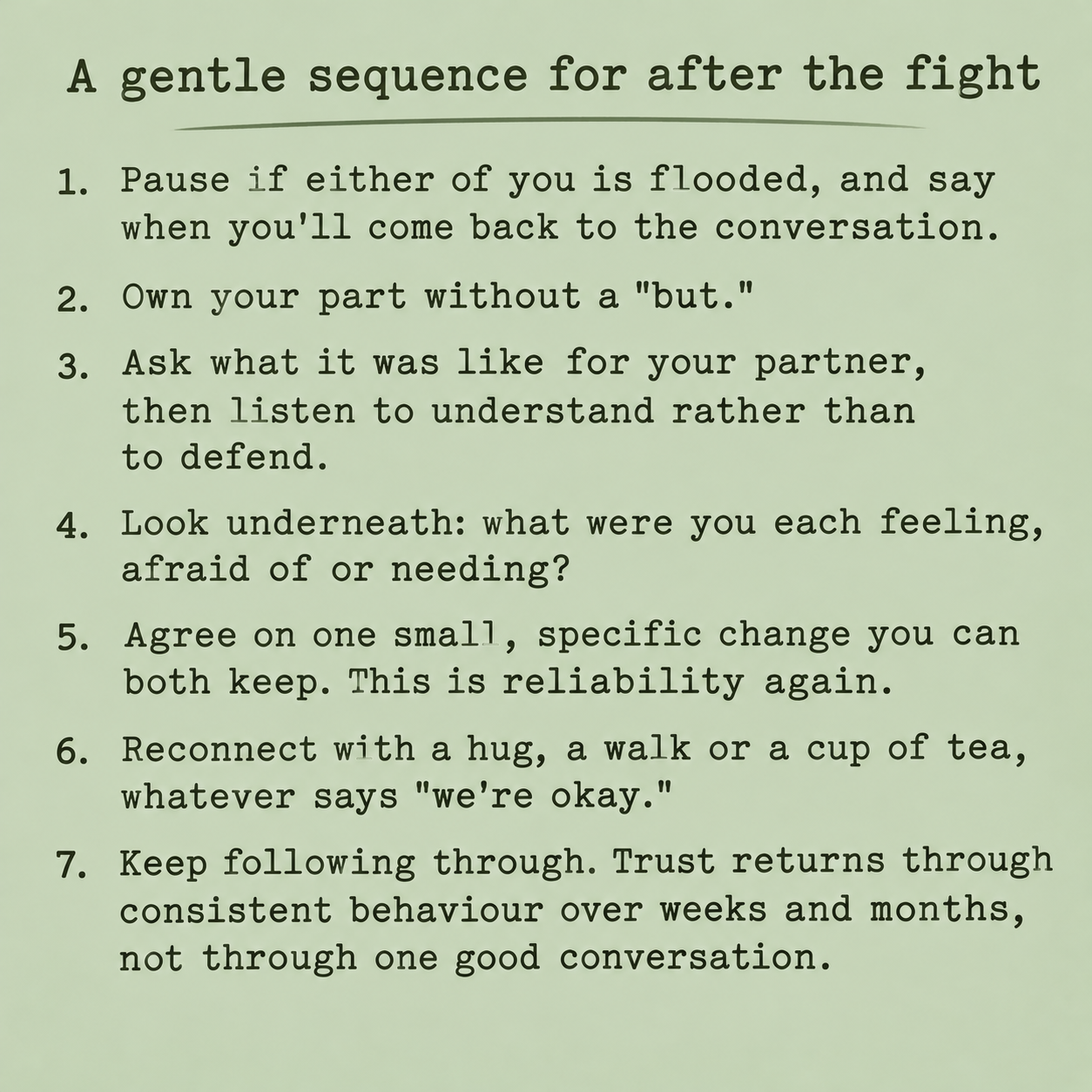
A gentle sequence for after the fight
- Pause if either of you is flooded, and say when you’ll come back to the conversation.
- Own your part without a “but.”
- Ask what it was like for your partner, then listen to understand rather than to defend.
- Look underneath: what were you each feeling, afraid of or needing?
- Agree on one small, specific change you can both keep. This is reliability again.
- Reconnect with a hug, a walk or a cup of tea, whatever says “we’re okay.”
- Keep following through. Trust returns through consistent behaviour over weeks and months, not through one good conversation.
One important note:
All of this assumes you both feel safe. If conflict in your relationship involves fear, control or violence, rebuilding trust isn’t the goal; your safety is. Please reach out to someone you trust or a professional, and in Ontario, 211 can connect you with local supports.
A small practice for this week
Trust doesn’t need a grand gesture. This week, pick just one thing: keep one small promise, share one thing you’ve been holding back, respond to a feeling before you offer a fix, or say out loud what you really mean. Then notice what shifts.
And if trust has been shaken and feels too heavy to repair on your own, you don’t have to do it alone. A registered psychotherapist can help you slow things down, hear each other, and find your way back to feeling safe together.
Relationship Counselling in Burlington and Across Ontario
Our team of experienced therapists support adults, couples, and families navigating anxiety, midlife transitions, complex family dynamics, and relationship challenges.
Our approach is warm, collaborative, and affirming of diverse identities and relationship structures, including ethical non-monogamy and open relationships.
📍 In-person sessions in Burlington, Ontario
💻 Virtual sessions available across Ontario
🗣️ Bilingual services in English and Spanish