


There are more types of burnout than most of us realize
It’s 3:47 on a Tuesday afternoon. You’ve read the same email four times and still can’t tell me what it says. Your coffee has been reheated twice and forgotten twice. Someone asks how you’re doing, and you hear yourself answer, “Good! Busy!” in the bright voice of someone who is absolutely not fine. That might be burnout, and there are more types of burnout than most of us realize.
Burnout comes up in my psychotherapy practice in Burlington, ON, a lot, and it’s one of the most misunderstood things people bring to me. We tend to picture a very tired person who just needs a spa weekend and an early night. Real life is messier than that, and burnout comes in more than one flavour. Knowing which kind you’re dealing with can change what actually helps.
(The people in the examples below are made up, but you’ll probably recognize the vibe.)
So, what is burnout, really?
Burnout is a state of deep physical, emotional, and mental exhaustion that builds up when stress goes on for too long without enough relief. The World Health Organization recognizes it as an occupational phenomenon rather than a medical condition. It describes three hallmarks: feeling drained, feeling distant or cynical about the work, and feeling less effective.
Although the official definition is about work, burnout doesn’t clock out. It happens to parents, caregivers, students, and anyone who has been giving a lot for a long time with too little coming back in.
Here’s what it can look like:
- Waking up tired, even after a full night’s sleep
- Sunday-evening dread that now shows up on Wednesdays too
- Feeling snappy, cynical, or oddly numb about things you used to care about
- Trouble concentrating, and a to-do list that makes you want to lie on the floor
- Headaches, stomach trouble, getting sick more often
- Pulling away from friends, family, or colleagues
- A creeping sense that nothing you do makes a difference
Burnout isn’t the same as a rough week, and it isn’t the same as depression, although the two can overlap and share symptoms. Burnout tends to feel tied to one area of your life, like your job or your caregiving role. Depression tends to spread into everything. Only a professional can tell you which one you’re dealing with, and that’s a perfectly good reason to ask.
The different types of burnout
Burnout isn’t a single experience. Researchers have described a few distinct profiles, and it can look different depending on where in your life it shows up. These types of burnout aren’t formal diagnoses, just useful lenses. Most of us recognize ourselves in more than one.
Three burnout profiles
The frenetic type (overload). Marcus says yes to everything. He answers emails at 10 p.m., takes pride in being “the one who can handle it,” and runs on adrenaline and coffee. His calendar looks like a game of Tetris that’s already lost. He has been “about to take a break” for what feels like forever. This type burns out from doing too much, too fast, with too little recovery, and the body eventually files its own complaint.
The under-challenged type (boredom and disengagement). Dana isn’t overworked. She’s under-stimulated. Her job hasn’t changed in years, nobody notices her ideas, and she feels indifferent and a bit cynical. She has reorganized her desktop icons three times this month, and it’s only the ninth. Sometimes called “boreout,” this burnout surprises people most because there’s no heroic workload to point to.
The worn-out type (neglect and helplessness). Sofia worked hard for years, spoke up, tried to change things, and got little recognition or control in return. So she stopped trying. That’s not laziness. It’s what happens after you’ve pushed on a door for years and nobody ever unlocked it. This type is marked by hopelessness and a feeling of “what’s the point?”
Burnout by where it shows up
Caregiver burnout. Lorena, 52, drives her mother to appointments, helps her teenager with applications, and answers every “How are you?” with “Fine!” She eats dinner standing at the counter and calls it efficient. Caring for an aging parent, a partner, or a child with high needs, often all at once, can drain you in ways that rest alone doesn’t fix. It’s especially common in midlife, when many people find themselves sandwiched between generations.
Parental burnout. This is more than ordinary parenting tiredness. It’s the exhaustion of feeling stretched past capacity, emotionally distant from your kids, and not like the parent you wanted to be, topped with a generous layer of guilt. If you’ve ever hidden in the pantry to eat a granola bar in peace, that’s not a character flaw. That’s a survival strategy.
Compassion fatigue. Nurses, teachers, social workers, first responders, and yes, therapists, spend their days holding other people’s pain. Over time, empathy can run low, and caring can start to feel like withdrawing from an account with no deposits. We’re human too, and we don’t have a secret method that makes us immune.
Many people are a mix. You can be frenetic at work and worn-out at home, or a burned-out caregiver who also feels invisible at the office. Naming the pattern is the first step toward changing it.
How burnout shows up differently in men and women
Burnout doesn’t check your gender at the door. Anyone can get it. But research suggests that the types of burnout people report, and the way they talk about it, can differ.
A large review of more than 180 studies found that women were more likely to report exhaustion. Men were more likely to report depersonalization, the cynical, detached “I just don’t care anymore” side of burnout (see the research summary). Those are averages, not rules, and results vary from study to study. You may well see yourself on the other side of the line.
How it often looks for women
Exhaustion tends to come first. Picture Elena, who finishes a full day at work and then clocks in for the “second shift”: dinner, homework, the family calendar, and remembering her aunt’s birthday. Researchers point to caregiving, housework, and expectations about who does what as part of the picture, although it isn’t fully settled.
Many women also describe a layer of guilt on top: I should be able to handle this. (Spoiler: you’re handling a lot more than one person’s share.)
How it often looks for men
Cynicism, irritability, and withdrawal tend to lead. Dev stops going to Thursday basketball, snaps at the kids about the dishwasher, and describes himself as “checked out.” He spends the weekend in the garage fixing things that weren’t broken. Asked how he is, he says “just tired,” roughly every day.
Because irritability and detachment don’t match the classic picture of exhaustion, men themselves, their families, and sometimes their doctors can miss burnout.
Beyond the binary
Most studies compare only men and women, so they say little about non-binary, trans, and gender-diverse people. They can carry added load, like educating colleagues or scanning every room for safety, and their burnout often goes unmeasured. If that’s you, your experience counts, even when the research doesn’t capture it.
The takeaway is simple. These patterns are tendencies, not destiny. Whatever your gender, if your usual way of showing stress has turned up louder than normal, take it seriously.
When to reach out for support, therapy included
The short answer: earlier than you think. You don’t have to wait for a full collapse to deserve help. Nobody hands out a prize for staying quiet until you’re in the ditch.
Whichever of the types of burnout you’re dealing with, it may be time to reach out if:
- It has lasted weeks or months, and rest (a weekend, a vacation) barely touches it
- Your sleep, appetite, or physical health is changing, with headaches, stomach trouble, or getting sick all the time
- You’re relying on alcohol, other substances, or endless scrolling to switch off
- You’re snapping at, or pulling away from, people you love
- You feel hopeless, numb, or stuck on “what’s the point?”
- Your work, parenting, or caregiving is slipping, and you’re scared of making mistakes
- You can’t picture feeling better, even though you’d like to
If you’re having thoughts of harming yourself or feeling like you can’t go on, please reach out right away. In Canada, you can call or text 9-8-8 at any time, day or night. If you’re in immediate danger, call 9-1-1.
What therapy for burnout can look like
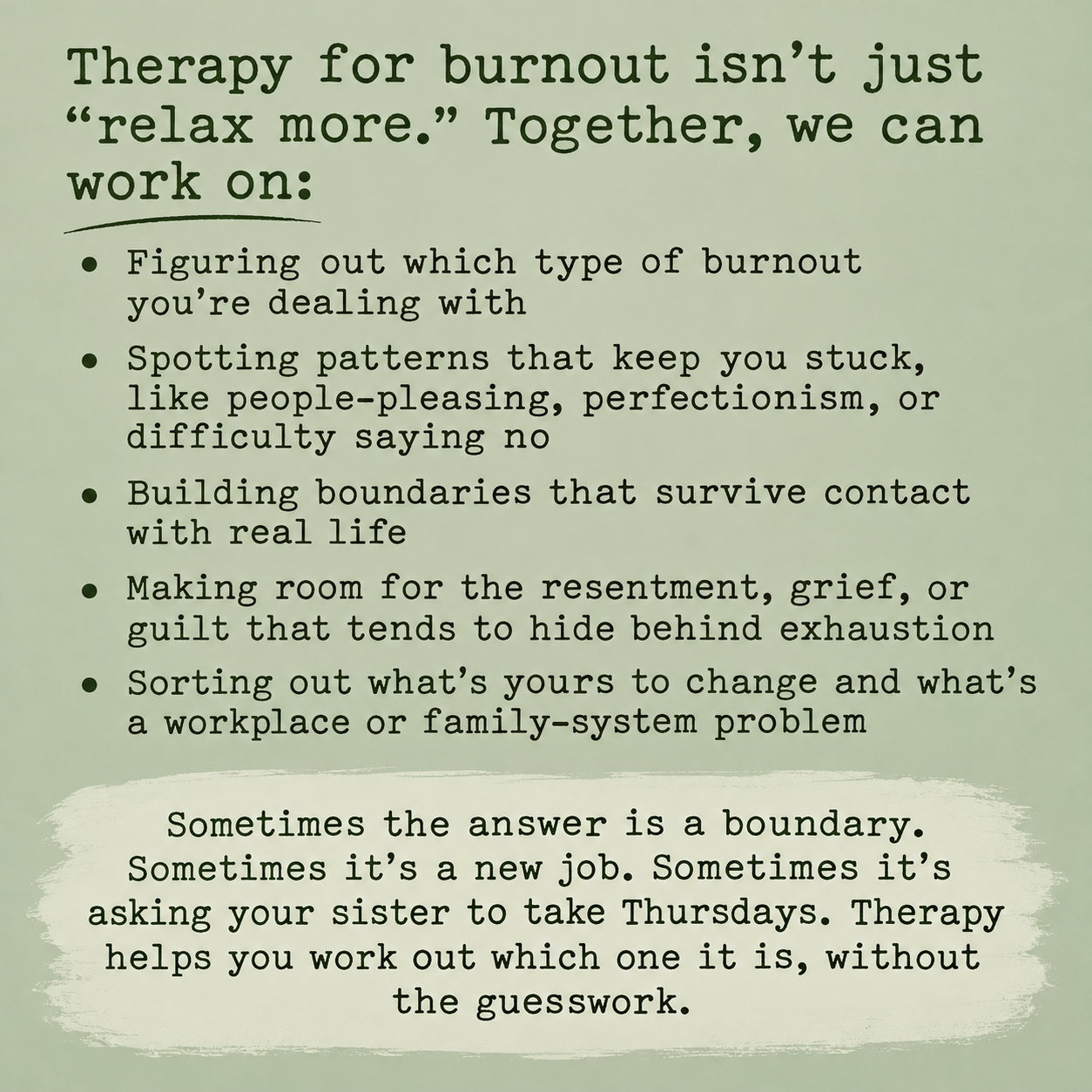
Therapy for burnout isn’t just “relax more.” Together, we can work on:
- Figuring out which type of burnout you’re dealing with
- Spotting patterns that keep you stuck, like people-pleasing, perfectionism, or difficulty saying no
- Building boundaries that survive contact with real life
- Making room for the resentment, grief, or guilt that tends to hide behind exhaustion
- Sorting out what’s yours to change and what’s a workplace or family-system problem
Sometimes the answer is a boundary. Sometimes it’s a new job. Sometimes it’s asking your sister to take Thursdays. Therapy helps you work out which one it is, without the guesswork.
Don’t skip your family doctor
Exhaustion can have medical causes too, such as thyroid problems, low iron, or sleep issues. A visit to your family doctor can rule those out and open the door to other supports, including time off work if you need it.
Burnout Q&A: your questions, answered
What’s the difference between stress and burnout?
Stress usually means too much: too many demands, too little time. Burnout is closer to having nothing left to give. Stress feels urgent and frantic. Burnout feels flat, heavy, and hopeless. If stress is a plate that’s too full, burnout is staring at the plate and not caring whether there’s food on it.
Will a vacation fix burnout?
A vacation helps, and you should take it. But it’s a pause, not a fix. If you return to the same workload, the same family dynamics, and the same lack of support, the glow lasts about as long as your tan. Lasting relief usually means changing something in the load, not only resting from it.
Can I burn out in a job or family I love?
Absolutely. In fact, people who care deeply are often the most at risk. Burnout doesn’t mean you chose the wrong life. Often it means you’ve been giving a lot without enough refills.
How long does it take to recover?
There’s no set timeline. For some people it’s weeks, for others it’s many months, and it depends on what’s driving it and whether anything changes. Recovery usually comes from small, steady shifts in rest, boundaries, and support rather than one big reset.
Do I have to quit my job to recover?
Not necessarily. Sometimes a job change is the right call, but often a conversation about workload, a boundary, extra support, or taking leave can make a real difference. Therapy can help you weigh your options before making a big decision.
How do I know if it’s burnout, depression, or anxiety?
They overlap, and the symptoms can look alike. Burnout tends to be tied to one area of life, while depression and anxiety tend to spread everywhere. A registered mental health professional or your family doctor can help sort it out, and you don’t need to have it figured out before you ask.
You don’t have to white-knuckle burnout alone
If you read about the types of burnout above and thought, well, that’s a bit too familiar, we’d be glad to help. You’ve been taking care of everyone and everything else for a long time. It’s okay to let someone take care of you for an hour.
Our team offers in-person sessions in Burlington and virtual sessions across Ontario, in English and Spanish. We work with adults and families, and our approach is warm, practical, and affirming of all identities and family structures.
Not ready to book? That’s okay too. Send a message with your questions using the Contact Form below.
This post is for general information and isn’t a substitute for professional advice. If you’re in crisis, call or text 9-8-8 in Canada, or call 9-1-1 in an emergency.