


That Voice in Your Head
You’re at the funeral. Everyone’s crying, hugging, saying the right words. And somewhere beneath the numbness, a voice in your head keeps repeating: Why them and not me? If I’d called sooner. If I’d pushed harder. If I’d just…
That voice has a name. It’s survivor’s guilt. And it’s more common than you think.
What Is Survivor’s Guilt?
Survivor’s guilt in grief is the persistent belief that you should have died instead of the person you lost — or that you somehow caused their death through something you did or didn’t do.
It shows up after all kinds of losses:
– A car accident where you walked away unharmed
– A sibling who passed from addiction while you stayed sober
– A friend who died by suicide and you were the last person to talk to them
– A workplace tragedy where colleagues didn’t make it home
– A pandemic where you survived and your neighbour didn’t
– A miscarriage or stillbirth where you’re healthy but your baby isn’t
Grief researcher Dr. Therese Rando, one of the most respected voices in bereavement, describes survivor’s guilt as a form of “self-blame” that can distort the grieving process and push someone toward complicated grief if left untreated. It’s not a character flaw. It’s a grief response.
Why Does It Happen?
Your brain is trying to make sense of something that doesn’t make sense. Loss feels random, and randomness is terrifying. So your mind reaches for a reason — and the easiest target is you.
Dr. Robert Neimeyer, a leading grief psychologist known for his meaning reconstruction theory, explains that after a loss, we desperately try to rebuild a coherent narrative. Sometimes that narrative includes a villain. And sometimes we cast ourselves in that role because it’s less frightening than accepting that bad things happen to good people for no reason at all.
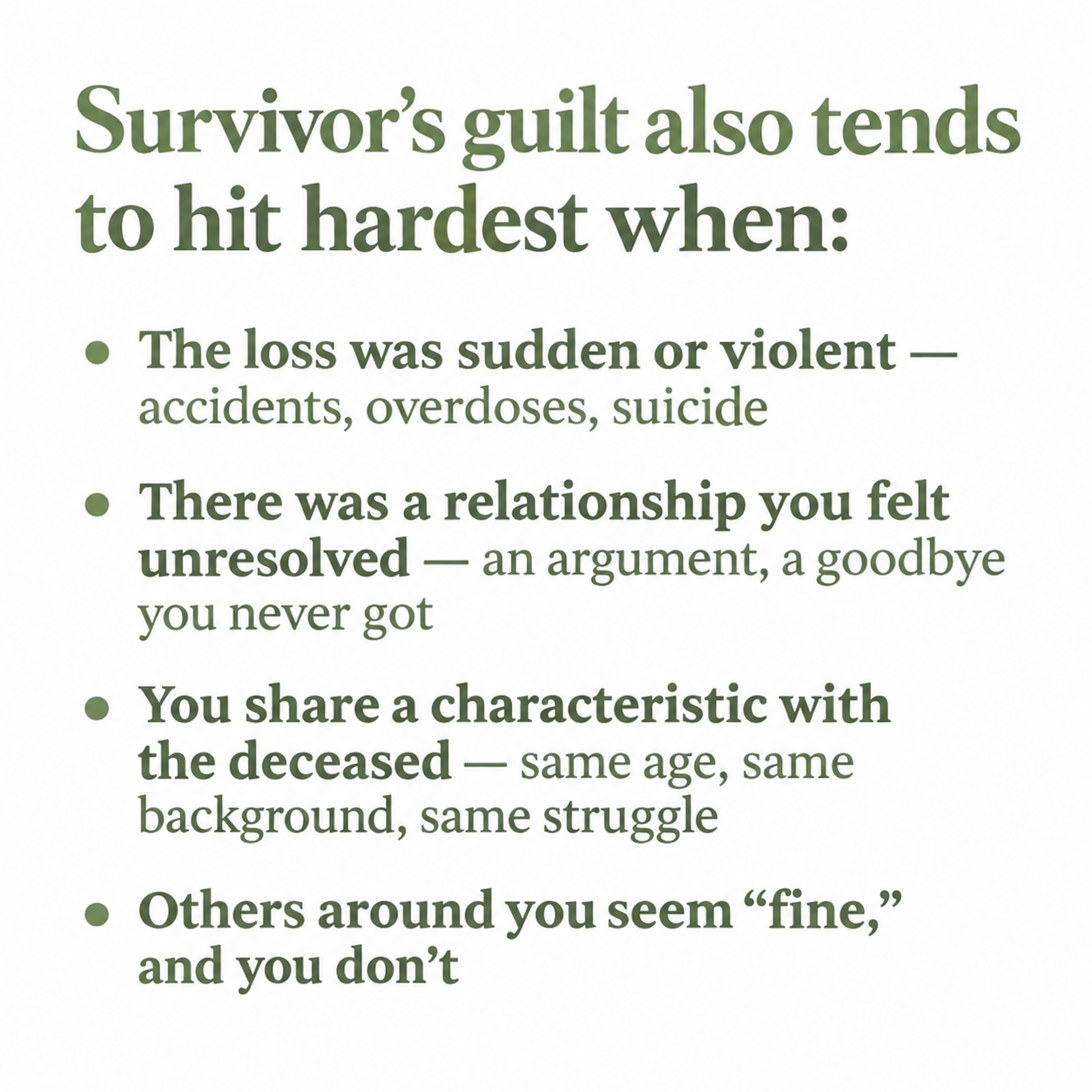
Survivor’s guilt also tends to hit hardest when:
– The loss was sudden or violent — accidents, overdoses, suicide
– There was a relationship you felt unresolved — an argument, a goodbye you never got
– You share a characteristic with the deceased — same age, same background, same struggle
– Others around you seem “fine,” and you don’t
What the Research Tells Us
While exact prevalence numbers vary, researchers consistently find that guilt appears in roughly half of bereaved individuals to some degree. A study published in the journal *Death Studies* found that guilt-related thoughts were among the most commonly reported symptoms following the loss of a loved one to suicide.
Closer to home, the Canadian Virtual Hospice — a Calgary-based resource trusted across Canada — notes that guilt is one of the most frequently submitted questions to their grief community. People are searching for the same thing you are: reassurance that they’re not broken, and help making sense of it.
How to Cope: What Actually Helps
Here’s the thing — you can’t logic your way out of survivor’s guilt. Telling yourself “it wasn’t my fault” once won’t silence the voice. But some approaches genuinely help over time.
1. Name it without judgment
Say it out loud or write it down: “I’m experiencing survivor’s guilt.” Naming it reduces its power. It moves the experience from something that’s happening *to* you to something you can look at.
2. Separate responsibility from causation
You may have been a cause in someone’s death in the most literal, physical sense. That’s different from being responsible. Most survivor’s guilt conflates the two. A therapist trained in grief work can help you untangle this.
3. Grieve without conditions
You don’t need to earn the right to grieve. You don’t need to have been “close enough” or “present enough.” Your loss is valid simply because you experienced it.
4. Consider trauma-informed therapy
Grief counsellor and author Joanne Cacciatore, who works extensively with traumatic loss, emphasizes that when guilt becomes obsessive or intrusive, it often needs more than supportive listening — it may need a trauma-informed approach. Somatic experiencing and mindfulness-based stress reduction have shown promise in addressing stuck grief patterns.
5. Find your people
Isolation feeds guilt. Grief support groups — in-person or online — remind you that you’re not the only one carrying this. The Canadian Virtual Hospice community and organizations like The Compassionate Friends (for bereaved parents) connect you with others who understand without explanation.
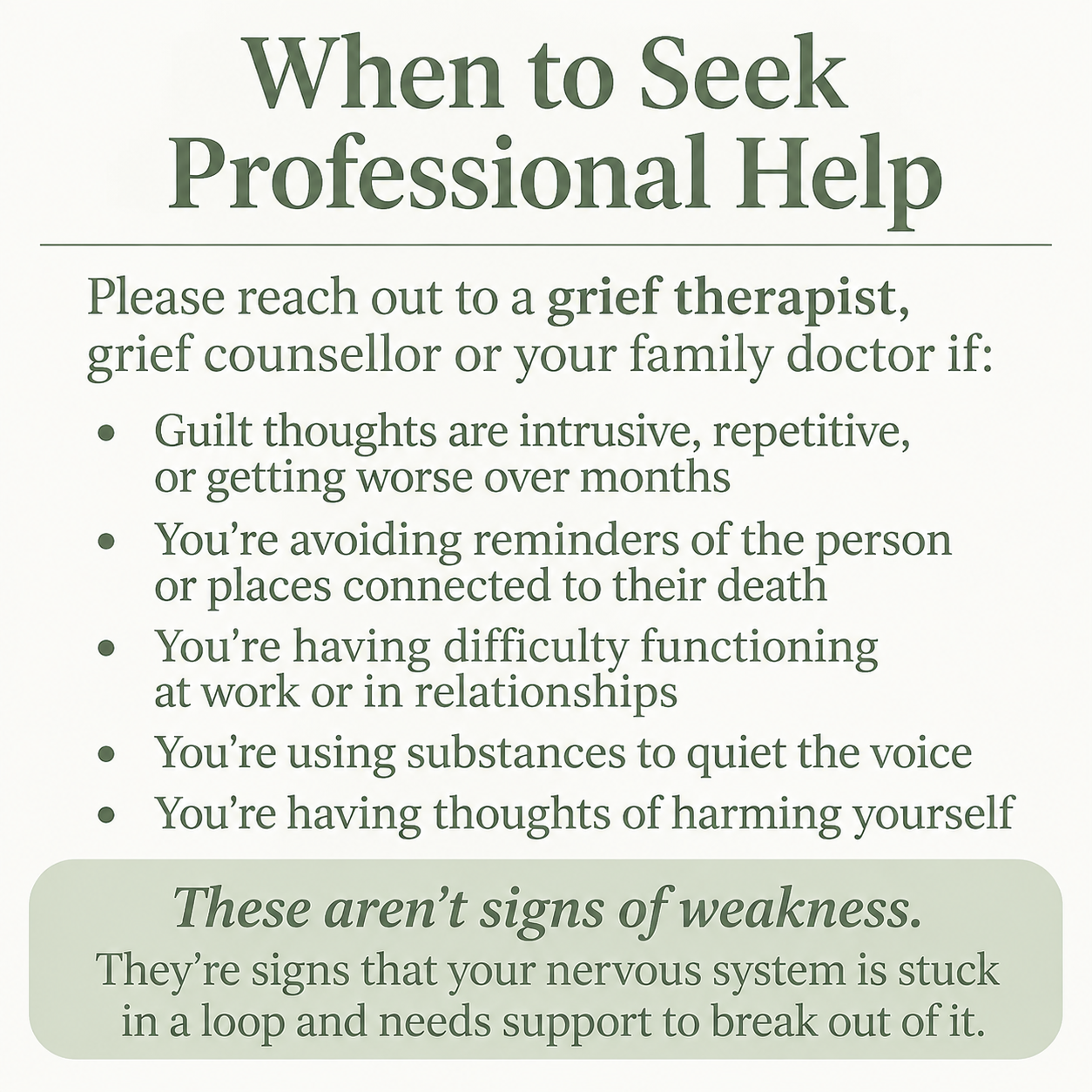
When to Seek Professional Help
Please reach out to a grief therapist, grief counsellor or your family doctor if:
– Guilt thoughts are intrusive, repetitive, or getting worse over months
– You’re avoiding reminders of the person or places connected to their death
– You’re having difficulty functioning at work or in relationships
– You’re using substances to quiet the voice
– You’re having thoughts of harming yourself
These aren’t signs of weakness. They’re signs that your nervous system is stuck in a loop and needs support to break out of it.
Canadian Resources for Grief Support
**Crisis Services Canada** | 1-833-456-4566 (24/7) or text 45645 (4 pm–midnight ET) |
**Hope for Wellness Helpline** | 1-855-242-3310 (Indigenous-focused, 24/7) |
**Canadian Virtual Hospice** | virtualhospice.ca — grief community, articles, Q&As |
**MyGrief.ca** | Evidence-based online grief program (University of Calgary) |
**Kids Help Phone** (under 21) | 1-800-668-6868 or text CONNECT to 686868 |
**Quebec residents** | 1-866-APPELLE (1-866-277-3553), 24/7 |
If you’re in immediate danger, please call 911.
Frequently Asked Questions
**Is survivor’s guilt the same as PTSD?**
Not exactly, though they can overlap. Survivor’s guilt is a cognitive and emotional pattern rooted in grief. PTSD involves trauma responses like flashbacks and hypervigilance. Some people experience both, especially after violent or sudden losses. A qualified clinician can help distinguish between them.
**How long does survivor’s guilt last?**
There’s no fixed timeline. For many people, the intensity softens over months to a couple of years with support. Without support, it can become a chronic companion. The good news: it responds well to targeted therapy.
**Can I still grieve if I feel relief?**
Yes. Relief and guilt often coexist, especially after a long illness or difficult relationship. Feeling relief doesn’t mean you didn’t love them. It means you’re human. You’re allowed to hold both truths at once.
**Is survivor’s guilt more common after suicide loss?**
Research suggests yes. Suicide loss carries unique layers of “what if” thinking that can intensify guilt. The Canadian Association for Suicide Prevention offers resources specifically for those bereaved by suicide.
**Does mindfulness help with survivor’s guilt?**
Mindfulness-based approaches can help you observe guilt thoughts without becoming entangled in them. Practices like loving-kindness meditation (directed toward yourself) and body scan exercises can reduce the physiological grip guilt has on your nervous system. At our practice, we integrate mindfulness into grief work in a gentle, trauma-informed way — no forced positivity, no “just let go” pressure.
You Don’t Have to Carry This Alone
Survivor’s guilt lies to you. It tells you that you don’t deserve peace, that you owe someone your suffering, that healing would be a betrayal. None of that is true.
You deserve support. You deserve a space where you can say the ugly, confusing, contradictory things without flinching. And you deserve a therapist who understands that grief isn’t a problem to solve — it’s a landscape to walk through, at your pace, with someone steady beside you.
If survivor’s guilt is weighing on you, we’re here. We offer compassionate, trauma-informed grief counselling tailored to where you are — whether that’s weeks after a loss or years into carrying something no one else knows about. You don’t need to have the right words. You just need to reach out.
You don’t have to earn your healing. You just have to begin.