


Is It Normal to Feel Burned Out as a Working Parent?
It is 6:47 a.m. Someone has lost a shoe, someone else has declared that toast is “too crunchy,” and your inbox already has three emails marked “urgent.” You haven’t had a hot coffee since about 2022.
If that sounds familiar, you are in very good company. Raising young kids while holding down a career is one of the most demanding things a person can do, and being tired, snappy, or stretched thin doesn’t mean you are failing at it. It means the load is heavy.
This guide pulls together Canadian and Ontario research on caregiver stress and burnout, then offers practical tools for your head, your work, your household and your relationship. Take what helps, skip what doesn’t, and please don’t add “read self-care article” to your to-do list as a task to feel guilty about.
Stress and burnout in the stay-at-home parent.
If you’re home with the kids full-time, you might hear “must be nice to have a day off,” usually from someone who has never negotiated with a toddler over a single sock.
The truth is, being a stay-at-home parent is a demanding job with no performance reviews, no lunch break, no weekends, and a boss who screams when you cut the snack the wrong way. The days can blur together, the work is repetitive and mostly invisible (nobody applauds a clean kitchen that will be wrecked in ten minutes), and the conversation is often limited to people under four feet tall.
It’s also easy to lose your sense of identity, feel isolated, or wonder who you are outside of “mom” or “dad.” Many stay-at-home parents also carry the lion’s share of the mental load, the constant planning and remembering that never clocks out.
Add worries about money or guilt about “not contributing enough,” and exhaustion can slide into burnout, leaving you feeling drained, numb, irritable, or resentful, even though you love your family. None of this means you’re ungrateful or doing it wrong. It means you’re a person with limits who needs rest, adult connection and support.
What the research says: you are not imagining it
The numbers back up what many parents already feel in their bones.
- Burnout is high, and working parents lead the pack. A Robert Half Canada survey of 1,500 professionals (March 2025) found 47% of Canadian workers feel burned out, up from 33% in 2023. Working parents (51%) and millennials (50%) were among the most burned-out groups.
- The mental load is real. An Ipsos survey for GreenShield (July 2026, 1,001 Canadian mothers with kids under 18) found that 92% feel responsible for tracking most family tasks. 65% feel overwhelmed often or very often, and 55% report burnout. 68% say the load is heavier at back-to-school time.
- Career decisions are on the line. A Pollara survey for CIBC found that 39% of Canadian women had considered quitting a job because of stress or burnout, compared with 25% of men.
- Money worries add fuel. The TELUS Mental Health Index (Q2 2025, 3,000 workers) found 49% of employees name financial concerns as their main personal stress, and 36% of Canadians, mainly younger workers and parents, feel overwhelmed by their responsibilities.
- In Ontario, a child’s struggles ripple into parents’ work. Children’s Mental Health Ontario found one in four Ontario parents had missed work to care for a child with anxiety, and 80% of parents said their work life was affected by a child’s mental health concern.
A note on language: the World Health Organization defines burnout as an occupational phenomenon, tied to chronic workplace stress. Many parents describe a similar bone-deep exhaustion from caregiving itself. Whatever you call it, it deserves attention.
Stress or burnout? How to tell
Stress is feeling like you have too much to do. Burnout feels like you have nothing left to do it. Stress usually eases when the busy stretch ends. Burnout lingers, even after a weekend or a holiday.
Common signs of burnout include:
- Exhaustion that sleep does not fix
- Feeling cynical, detached or “done” with work or family routines
- Irritation over small things (the cereal bowl left on the counter becomes a moral failing)
- Trouble concentrating, forgetting things, feeling like you have lost control
- Headaches, stomach trouble, frequent colds or insomnia
If several of these have lasted for weeks, talk to your family doctor or a mental health professional. And if you are ever in crisis, call or text 988, the Suicide Crisis Helpline, any time.

Tools for stress: small, realistic and parent-proof
Forget the 90-minute morning routine. These fit into the cracks of an actual day.
- The 60-second reset. Breathe in for four counts, out for six, three times. Do it in the car, in the bathroom, or while the kettle boils. Slow exhales tell your nervous system the tiger is not, in fact, a toddler.
- Name it to tame it. Say to yourself, “I’m feeling overwhelmed,” instead of “I can’t do this.” Naming an emotion creates a little distance.
- The brain dump. Write every swirling task on paper, then circle the three that matter today. The rest can wait. Nobody has ever died of an unfolded fitted sheet.
- Lower the bar on purpose. Cereal for dinner is a meal. “Good enough” is a legitimate parenting and career strategy.
- Move a little. A ten-minute walk with the stroller, the dog or a podcast counts. Consistency beats intensity.
- Protect sleep where you can. Trade nights with your partner, if you have one, so each of you gets a few protected hours. Sleep is not a luxury, even though it is priced like one.
- Try a mindful minute. Pick one daily task, such as washing dishes or the walk to daycare, and give it your full attention. Notice sounds, temperature and breath. It is mindfulness without the incense.
Tools for work and career: boundaries without burning bridges
Workers in the Robert Half survey named heavy workloads and long hours (39%) and mental fatigue (38%) as top burnout drivers, and said the most helpful employer responses were time off, extra staffing and better-prioritized projects. You may not control your workplace, but you can control some of how you work in it.
- Name your non-negotiables. Daycare pickup at 5:15 is not a character flaw. Decide what is fixed, then say it plainly and early.
- Ask for specific flexibility. “Could I start at 8 and finish at 4, with a catch-up block after bedtime if needed?” is easier to approve than “I need balance.”
- Batch and protect focus time. Check email at set times, not all day. Fewer context switches mean less mental fatigue.
- Say no, kindly. “I can’t take that on this week. I can do it by Thursday, or hand off X instead.” Offer trade-offs, not apologies.
- Use your time off. Take the vacation days and the mental health day. They exist for a reason.
- Plan for transitions. Returning from leave, a new baby, or a promotion all reset the juggling. Review your setup every few months and adjust.
And if you have been quietly fantasizing about quitting, treat that as information, not a failure. It may point to a boundary, workload, or role that needs to change.
Tools for family life: share the mental load, not just the chores
The mental load is the invisible work of planning, remembering, and anticipating: noticing the permission slip is due, the snow pants no longer fit, and the milk is running low. In the GreenShield survey, 75% of mothers said they are mainly responsible for scheduling and planning, and 74% for remembering dates and tasks. Research from McGill using Canada’s General Social Survey also found that women who held sole responsibility for household chores were more likely to be dissatisfied with their work-family balance.
Try this at home:
- Make the invisible visible. Together, list everything it takes to run your household, including the thinking tasks. Most couples are surprised by how long the list is.
- Hand over whole jobs. Give your partner full ownership of a task, from noticing to planning to doing, instead of “helping” with your list. Ownership means no reminders and no re-checking.
- Hold a 15-minute weekly huddle. Review the calendar, meals, and who is covering what. Put it in a shared calendar app, not in one person’s head.
- Agree on “good enough.” If a task is done differently, it is still done. Resist the urge to redo the dishwasher.
- Ask for help early. Grandparents, neighbours, a babysitter swap with another family, or paid help for one chore. Support is a strategy, not a confession.
- Single parent? You are carrying this with fewer hands. Statistics Canada’s 2012 General Social Survey found 67% of lone parents were satisfied with their work-life balance, compared with 76% of couple parents. Lean on your village, and ask for help without apology.
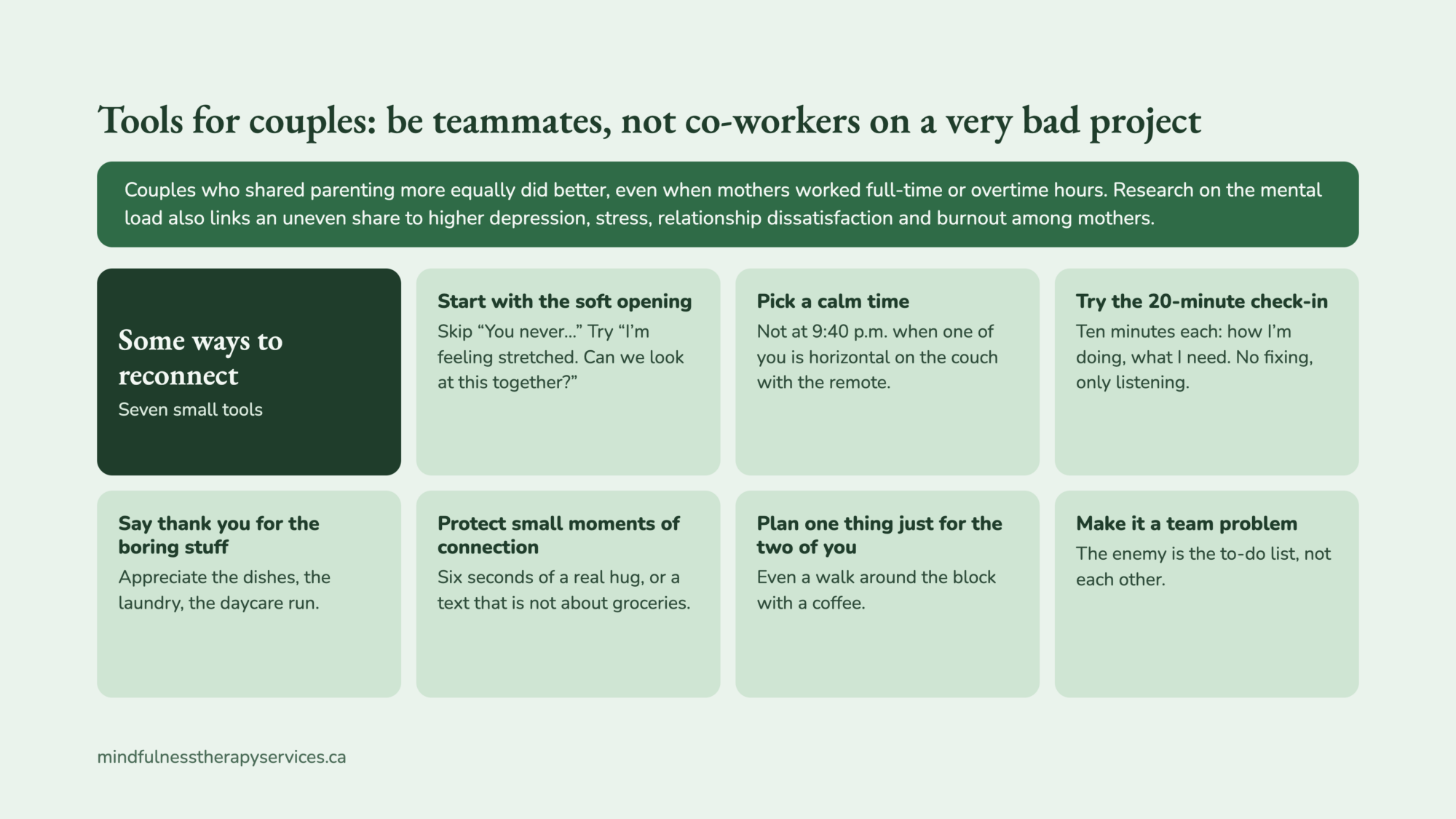
Tools for couples: be teammates, not co-workers on a very bad project
When you’re both exhausted, your relationship can start to feel like a shared calendar with occasional logistics texts.
A study of employed parents in Canada found that when working mothers saw the division of parenting as unfair, their relationship quality suffered. Couples who shared parenting more equally did better, even when mothers worked full-time or overtime hours. Research on the mental load also links an uneven share to higher depression, stress, relationship dissatisfaction and burnout among mothers.
Some ways to reconnect:
- Start with the soft opening. Instead of “You never…,” try “I’m feeling stretched, and I’d like us to look at this together.”
- Pick a calm time. Not at 9:40 p.m. when one of you is horizontal on the couch holding the TV remote like a lifeline.
- Try the 20-minute check-in. Each person gets ten uninterrupted minutes to share how I’m doing and what I need this week. No fixing, only listening.
- Say thank you for the boring stuff. Appreciation for the dishes, the laundry or the daycare run goes a long way.
- Protect small moments of connection. Six seconds of a real hug, a text that is not about groceries, or ten minutes of eye contact after the kids are asleep.
- Plan one thing that is just for the two of you, even if it is a walk around the block with a coffee while the kids are at your parents’.
- Talk about the division of labour as a team problem. The enemy is the to-do list, not each other. This applies to all kinds of couples, and mothers partnered with women have been reported to share the mental load more equitably, a reminder that roles can be negotiated rather than assumed.
If conversations keep ending in the same argument, couples therapy can give you a neutral space and new tools.
Q&A: questions tired parents actually ask
Is it normal to feel this exhausted? Very. Surveys suggest more than half of Canadian mothers report burnout, and working parents are among the most burned-out workers. Common does not mean fine, though. It means you deserve support.
I love my kids. Why do I feel resentful sometimes? Because you are a human being with limits. You can love your children deeply and still feel depleted, angry or trapped by the daily grind. Resentment often signals that something in the load needs to change.
How do I know if it is burnout or depression? The two can overlap, with exhaustion, low mood, and loss of interest. A doctor or therapist can help sort it out. Don’t wait to be sure before asking for help.
My partner says they are just as tired. How do we decide whose turn it is to rest? Swap the contest for a schedule. Each of you gets protected rest or solo time each week, written down, and you cover for each other. It does not have to be equal minute-for-minute, but it should feel fair to both of you.
Should I cut back my hours or quit? That depends on your finances, your workplace and your values. Before you make a big decision, try changing what you can: your workload, flexibility, and help at home. A therapist can help you think it through without pressure.
Do I have to wait until I’m at breaking point to see a therapist? No. Therapy is useful for prevention, not only for crisis.
What if I cannot afford therapy or cannot find the time? The provincial Ontario Structured Psychotherapy Program offers free therapy for adults with anxiety or depression, though there can be a wait. Many extended health plans cover sessions with a Registered Psychotherapist and Registered Social Workers, and virtual sessions can save commuting time. Ask about evening hours.
Why therapy can help
If you read this guide and thought, “Great ideas, but I am too tired to try them,” that is exactly when therapy can help. It gives you a dedicated hour that is only about you.
- A space that is yours. No one needs a snack, a signature or a decision. You can say the honest things you can’t say at work or at the playground.
- Tools tailored to your life. Approaches such as cognitive behavioural therapy (CBT) and mindfulness-based work help you notice stress patterns, challenge harsh self-talk, and build routines that fit your real schedule.
- Help with the guilt. Many parents carry a quiet “I should be doing better.” A therapist can help you replace that with self-compassion and realistic expectations.
- Support for your relationship. Couples therapy can help you communicate under pressure, share the load more fairly, and reconnect.
- Clarity on career decisions. Whether you’re considering a leave, a role change, or returning to work, talking it through can reduce panic and sharpen your choices.
- Earlier help, fewer crises. Waiting until you hit the wall makes recovery harder. In the GreenShield survey, time and cost were the main reasons parents delayed care, so look for evening appointments, virtual sessions and benefits coverage.
Ready to start?
We offer in-person sessions in Burlington and virtual sessions across Ontario, in English and Spanish, for individuals and couples navigating anxiety, burnout, midlife transitions, grief, trauma and relationship and intimacy issues.
Our therapists are Registered Psychotherapists of Ontario (CRPO) and Registered Social Workers (OCSWSSW).
Contact us for a free consultation and take a small first step.