


Understanding Grief Therapy and When to Reach Out
There’s a particular kind of exhaustion that comes with grief. It’s not just tiredness — it’s the kind that settles into your bones, the kind that makes even the simplest things feel impossibly heavy. Getting out of bed. Answering a text. Making coffee. Things you used to do without thinking suddenly feel like mountains.
If you’ve been there, you might have found yourself wondering: Is this grief? Or is something else going on? Am I depressed?
That question is more common than you might think, and more important than it gets credit for. Let’s talk about it.
What Is Grief?
Grief is the natural, deeply human response to loss. Most of us think of grief in the context of death, and yes, losing someone you love is one of the most profound losses there is. But grief shows up in so many other places too.
Grief can follow the end of a relationship, even one that needed to end. It can come after a miscarriage, a job loss, a diagnosis, or a move that takes you away from everything familiar. It can show up when a friendship fades, when a child grows up and leaves home, or when you finally reckon with a childhood that wasn’t what it should have been.
Grief is the price of love and attachment. It means something mattered to you. And that’s not a flaw — that’s being human.
Can Grief Feel Like Depression? The Big Question
Yes. Absolutely, genuinely yes — and this is where things can get confusing and even a little scary.
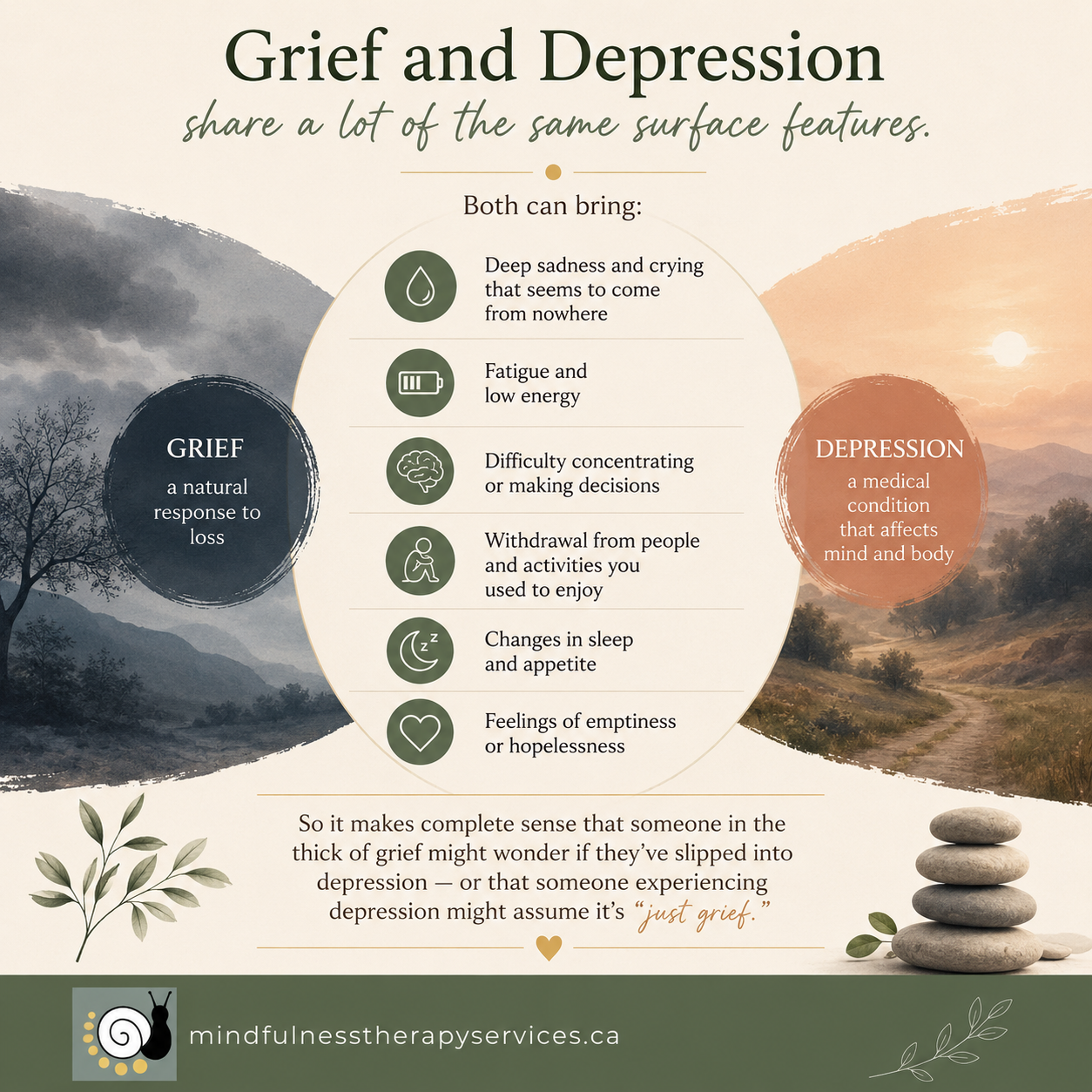
Here’s a helpful way to think about the difference.
Grief tends to come in waves. You might have a few hours, or even a day, where you feel almost okay — and then something triggers it again. A song. A smell. An ordinary Tuesday. The pain is real and deep, but it’s not usually constant every single moment. And at the core of grief, even in the darkest moments, there’s often still a sense of self. You still know who you are, even if the world feels different without the person or thing you’ve lost.
Depression, on the other hand, tends to be more of a constant fog. The low mood is pervasive — not just triggered by reminders of the loss. Depression often brings a more profound sense of worthlessness, a feeling that you are the problem, not just that your world has changed. It can make everything feel flat and pointless, even things completely unrelated to the loss.
That said, and this is important, grief can become depression. Especially when a loss is sudden, traumatic, or when there’s little support around you. What’s sometimes called “complicated grief” or “prolonged grief disorder” can look and feel very much like clinical depression, and it deserves real attention and care.
The bottom line? You don’t have to diagnose yourself. That’s what we’re here for. But if you’re asking the question, you’re already doing something brave — paying attention to what’s happening inside you.
What Is Grief Therapy?
Grief therapy is a supportive, guided process that helps you move through loss rather than around it or under it.
It’s not about being fixed, because you’re not broken. And it’s definitely not about being told to “move on” or “look on the bright side.” (If one more person tells you they’re in a better place now, right?)
Grief therapy offers you a space, a real, protected, judgment-free space, to say out loud what you’ve been carrying. To name what you’ve lost. To feel angry, or guilty, or relieved, or all three at once, without having to manage anyone else’s discomfort about it.
Depending on what you’re going through and what feels right for you, grief therapy might involve:
Talking through the loss — telling the story of who or what you’ve lost, what they meant to you, and what life looks like now. Sometimes just being truly heard by another person is profoundly healing.
Making sense of complicated feelings — grief is rarely just sadness. There’s often anger, guilt (“I should have called more”), relief (especially after a long illness or a difficult relationship), and sometimes even moments of joy or gratitude, which can themselves feel confusing. Therapy helps you make room for all of it.
Addressing depression or anxiety — if grief has tipped into something that looks more like clinical depression, or if anxiety has become part of the picture, therapy can address those layers directly.
Mindfulness and body-based approaches — grief lives in the body as much as the mind. Approaches that help you stay present with difficult feelings rather than avoid them can be incredibly powerful. This is something I care deeply about in my approach to grief therapy.
Finding meaning and a new way forward — not “getting over it,” but learning how to carry the loss and still live fully. Grief changes and transforms us. Therapy can help make sure it changes us in ways we can live with.
Some Real Moments That Bring People to Grief Therapy
People come to grief therapy from all kinds of places. Maybe you recognize yourself in some of these.
Someone who lost her mother and thought she was doing okay by keeping busy, staying strong for her kids. But lately she can’t sleep, she’s snapping at her husband over nothing, and she cries in her car in parking lots so nobody sees her. She keeps thinking: it’s been two years, why am I still like this?
There’s no expiry date on grief. Two years, five years. Loss doesn’t follow a calendar.
A person who ended his marriage after 14 years. He knows it was the right decision. But he grieves the life he thought he’d have, the family he imagined, and he feels guilty for grieving something he chose. He wonders if he’s allowed to feel this way.
You are always allowed to feel what you feel. Grief doesn’t require a tragedy. It requires love and loss.
A young adult received a diagnosis that changed her future. She’s not dying, she tells herself; there are people dealing with so much worse. But she’s mourning the version of her life she’d planned, and she’s struggling to let herself grieve something that feels like it “shouldn’t” be a big deal.
All loss is real loss. Comparison doesn’t make your grief smaller. It just makes you lonelier.
When Should You Reach Out for Grief Therapy?
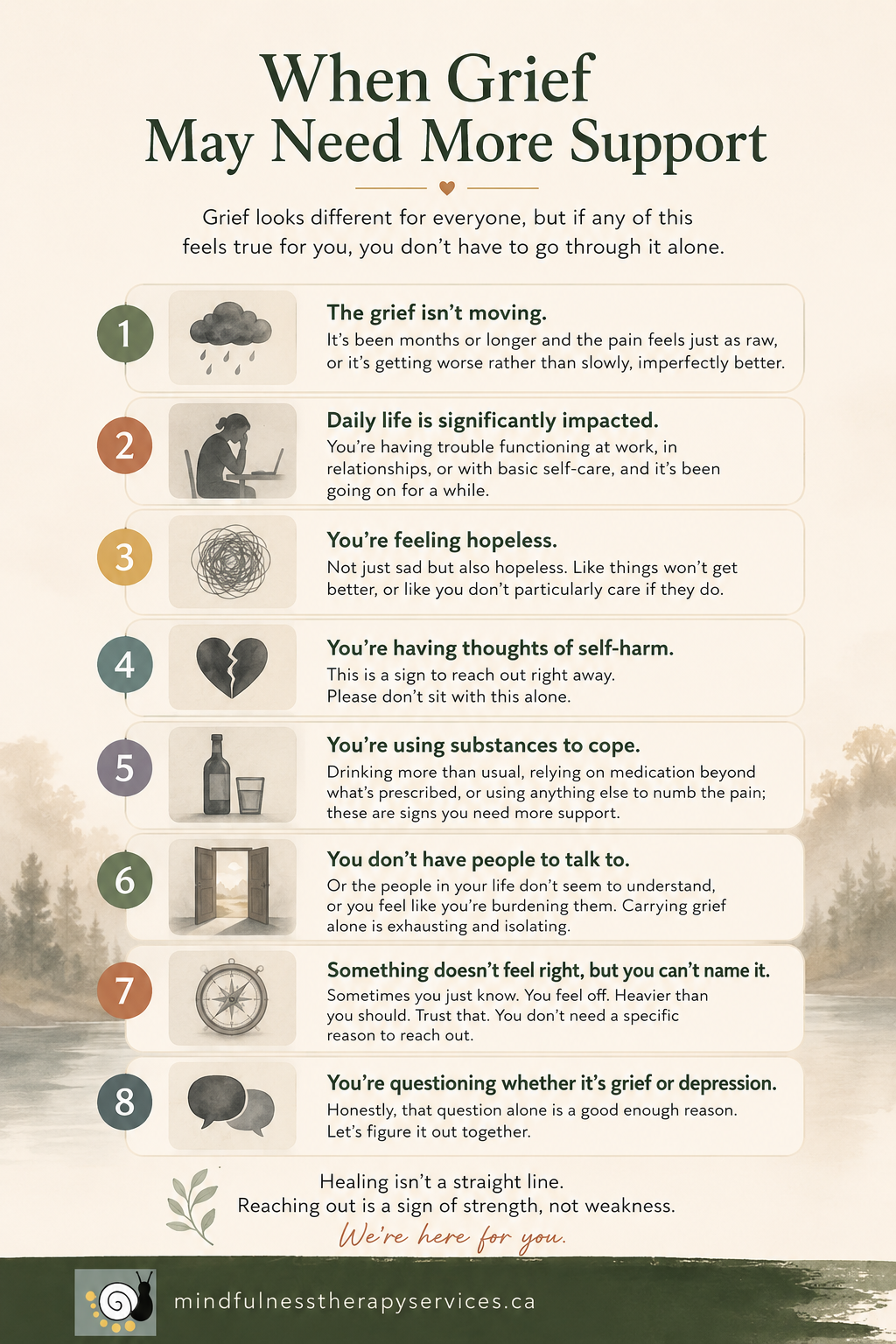
There’s no wrong time to reach out; here are some signs that talking to someone might really help:
You Don’t Have to Earn the Right to Grieve
One of the most painful things we hear from people who come to grief therapy is some version of: I don’t know if my loss is “big enough” to deserve this.
Grief is always big enough. You are always allowed to grieve what you’ve lost. A pet. A pregnancy. A friendship. A dream. A version of yourself. The childhood you deserved but didn’t get. Your health. Your sense of safety.
Grief doesn’t have a hierarchy. Pain is pain, and you deserve support with it.
Frequently Asked Questions: Signs grief might be depression
What are the signs that grief might be turning into depression? The biggest sign is constancy. Grief tends to come in waves, with moments of relief in between, while depression tends to feel like a fog that doesn’t lift, even on days nothing reminds you of the loss. If the low mood, exhaustion, or hopelessness feels nonstop rather than triggered, that’s worth paying attention to.
Is it normal to still feel this way two or three years after a loss? Yes. Grief doesn’t follow a calendar, and there’s no expiry date on missing someone or something you’ve lost. That said, if the intensity hasn’t shifted at all over a long period, or it’s getting worse instead of easing, it may be a sign that grief has tipped into something like prolonged grief disorder or depression, and support can help.
How is depression after a loss different from “just grieving”? Depression often brings a deeper sense of worthlessness, like you are the problem rather than the loss being the problem. It tends to flatten everything, even things unrelated to what you lost, whereas grief usually still leaves room for a sense of self underneath the pain.
Can grief and depression happen at the same time? Yes, and this is common, especially after a sudden or traumatic loss, or when there’s little support around you. This is sometimes called complicated grief or prolonged grief disorder, and it can look and feel very similar to clinical depression.
Do I need a diagnosis before reaching out for help? No. You don’t have to know whether what you’re feeling is grief, depression, or both before booking a consultation. Naming the difference is something a therapist can help you with; it’s not a prerequisite for getting support.
When should I consider talking to someone? If sleep, relationships, or daily functioning are being affected, if you’re hiding how bad it feels from people around you, or if you’re simply not sure what you’re feeling but know something isn’t right, that’s a good time to reach out. There’s no minimum threshold of pain required to deserve support.
A Note on Grief and Mindfulness
Our team in our Burlington in-person offices or virtually across Ontario often work with grief through a mindfulness lens, not because we want you to meditate your grief away (that’s not how this works), but because mindfulness teaches us to allow difficult feelings to run their course without being overwhelmed by them or running from them.
People who repress their emotions often experience them resurfacing as unexplained anxiety, sudden outbursts, or even physical pain
Grief asks us to be present with something unbearable. Mindfulness gently builds that capacity, one moment at a time. It can help you stop fighting the waves and start learning to float in them.
Ready to Talk?
If anything in this post resonated with you, if you’re nodding along, or if your chest felt a little tight reading it, please know that reaching out is an act of courage, not weakness.
You don’t have to have it all figured out before you call. You don’t have to know exactly what you’re grieving, or have the right words for it, or even be sure that therapy is right for you. That’s what the first conversation is for.
We’d be honoured to walk alongside you.
Visit us at mindfulnesstherapyservices.ca to learn more about our in-person services in Burlington and Halton Region, or our virtual services across Ontario, or contact us for a free consultation.
If you are in crisis or having thoughts of suicide or self-harm, please reach out to the Canada Suicide Prevention Service at 1-833-456-4566 (available 24/7), or text HOME to 686868 to reach Crisis Services Canada.