


Grief Years After Losing Someone?
Maybe it caught you off guard in the cereal aisle at NoFrills or Costco. A song came on, a certain smell drifted by, or you saw someone with the same walk, and suddenly you were right back there, missing them the way you did in the very first weeks. And then came the second wave: why am I still like this? It’s been years.
Grief doesn’t run on a calendar, and it doesn’t politely wrap itself up after a “reasonable” amount of time. For many people, love simply doesn’t have an expiry date, and neither does missing the person it was attached to.
Let’s talk about why grief lingers, what the research actually says about it, and how to tell the difference between grief that’s doing what grief does and grief that could use some extra support.
Is It Normal to Still Grieve Years Later?
Yes. Genuinely, wholeheartedly, yes.
I have been in therapy for a long time, not only to work on my historical issues but also to maintain a good level of self-care and personal growth as a psychotherapist. No matter how much intense work I have done on navigating grief, a picture, a song, or certain places evoke in me profound sentiments and even tears connected to a loved one who died years ago.
For a long time, popular culture (and even some older psychological models) suggested grief should move through a set of stages and then resolve; that “closure” was the goal, and if you weren’t there yet, something had gone wrong. That framework has aged badly. Grief researchers today largely agree that grief isn’t something you finish; it’s something you learn to carry differently.
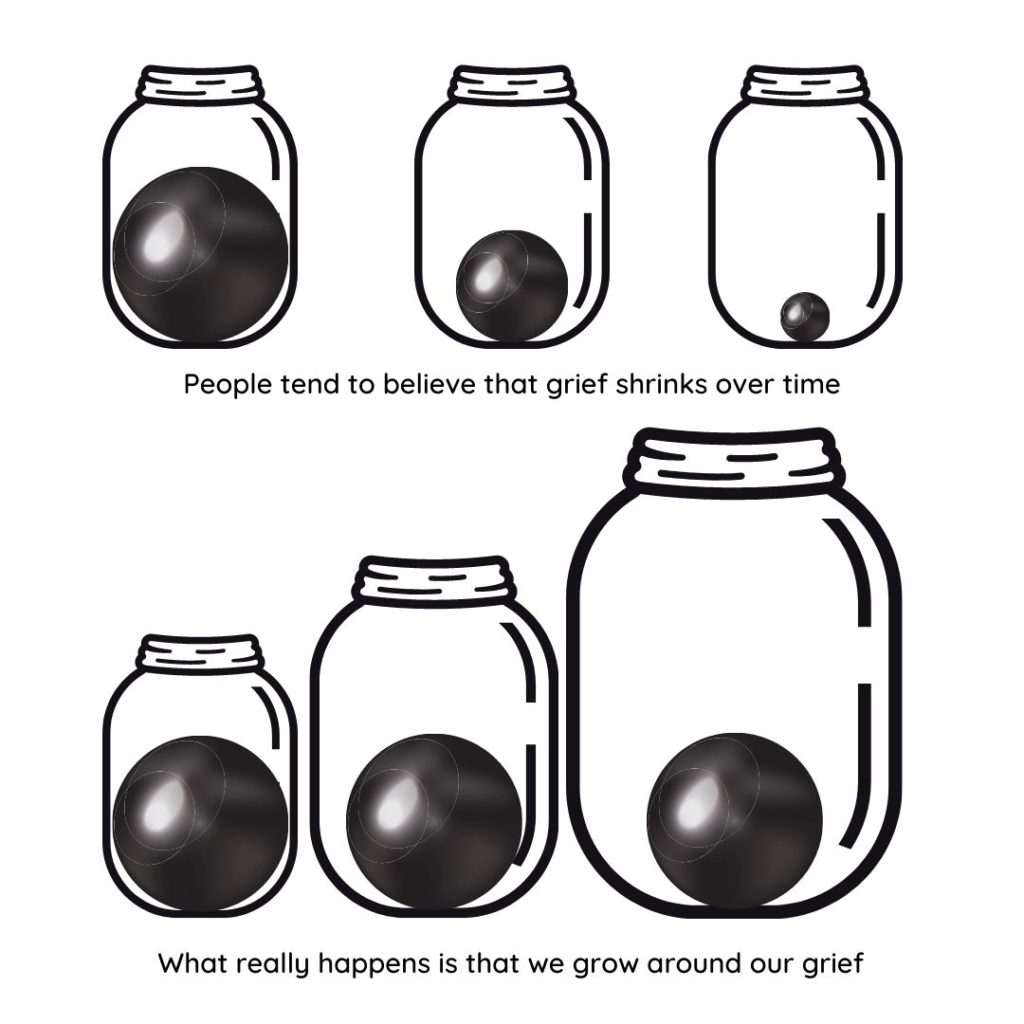
Bereavement researcher George Bonanno’s work on grief trajectories found that while many people do adapt to loss over time without it dominating their day-to-day life, that adaptation rarely means the loss stops mattering. It means the loss becomes woven into a life that keeps growing around it, rather than staying the size it was on day one.
Why Grief Doesn’t Just “Go Away”
Older theories, including Freud’s and later John Bowlby’s, framed healthy grieving as detaching from the person who died, cutting the emotional cord so you could reinvest in new relationships. It’s an understandable idea, but it doesn’t match how most people actually experience loss.
In the 1990s, researchers Dennis Klass, Phyllis Silverman, and Steven Nickman offered a different lens, now widely known as continuing bonds theory. Their research found that maintaining an ongoing inner relationship with someone who died. Such as talking to them, keeping their belongings close, carrying their values forward, and marking anniversaries is a normal and often healthy part of grieving, not a sign that someone is “stuck.”
This idea has held up well and has even reshaped how later grief models describe healthy mourning, including William Worden‘s influential “tasks of mourning” framework, which was revised to include finding an enduring connection with the person who died, rather than simply moving on.
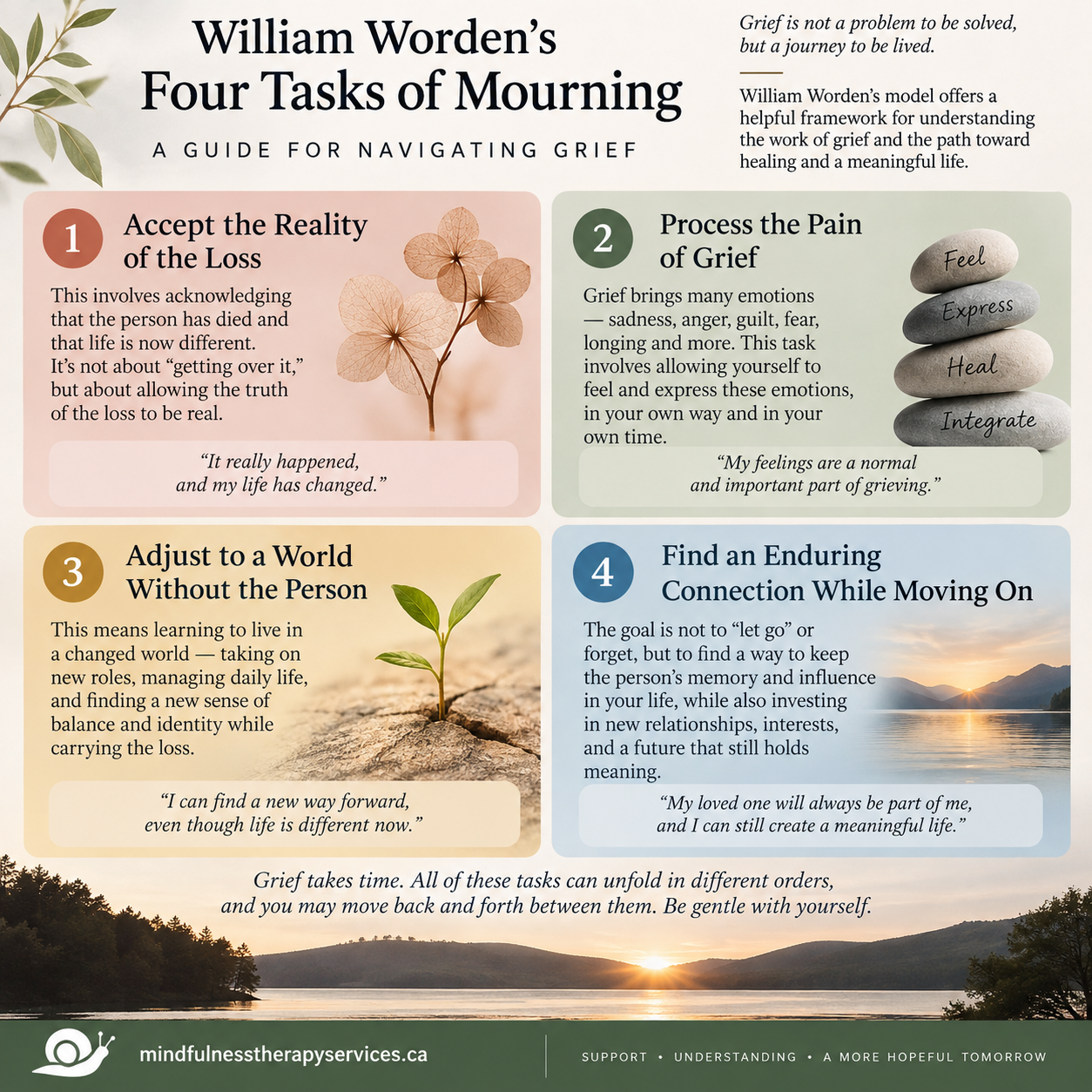
So if you still set two coffee cups out of habit, still ask your dad what he’d think of a decision, or still feel your grandmother’s presence when you cook her recipe, that’s not unresolved grief. That’s a bond, still doing what bonds do.
Why Grief Isn’t a Straight Line
Elisabeth Kübler-Ross’s five stages: denial, anger, bargaining, depression, acceptance. They are probably the most quoted grief framework there is. What often gets lost is that she developed them by studying terminally ill patients coming to terms with their own dying, not bereaved people mourning someone else, and she never intended them as a fixed checklist everyone works through in order.
In real life, grief tends to move in waves rather than stages.
Grief counsellor Lois Tonkin described this well with a simple image: imagine grief as a ball inside a box, and inside that box is a pain button. At first, the ball is huge; it fills the box and constantly presses the button. Over time, the ball doesn’t necessarily shrink. Instead, the box, your life, grows bigger around it. Most days, the ball sits quietly in a corner. But every so often it rolls, hits the button, and the pain feels every bit as sharp as it did at the beginning. Anniversaries, milestones your person is missing, a familiar song. These are just the moments the ball rolls.
Why Certain Days Hit Harder: Understanding Anniversary Reactions
If your grief seems to spike around a particular date, like a birthday, the anniversary of the death, a holiday, even a season, that’s a well-documented and very common experience often called an anniversary reaction. Your body and mind can hold onto the emotional imprint of a date even before you consciously register why you feel off.
This isn’t a setback in your healing. It’s a sign of how deeply the relationship mattered, resurfacing right on schedule.
When Grief Becomes Something More: Prolonged Grief Disorder
Most people, with time and support, find their grief softens into something they can live alongside. It still visits, but it doesn’t run the show. For a smaller number of people, grief stays acute, disabling, and unrelenting well beyond what’s expected, and that’s worth naming too.
The DSM-5-TR now includes a diagnosis called Prolonged Grief Disorder (PGD). It can only be considered starting at least twelve months after the death (six months for children and adolescents), and it involves an intense, persistent grief response. Such as overwhelming yearning for the person or preoccupation with thoughts of them, occurring nearly every day, along with significant difficulty functioning in daily life, well beyond what’s typical for someone’s culture and circumstances.
There’s an important difference between grief that resurfaces and grief that never eases. If your grief has remained just as consuming as it was in the first weeks, with no shift at all after a year or more, and it’s interfering with work, relationships, or basic functioning, that’s worth exploring with a professional.
This diagnosis exists to make sure people whose grief has become genuinely stuck can access targeted support, not to pathologize the ordinary ache of missing someone years later.
How to Support Yourself When Old Grief Resurfaces
- Let the wave be a wave, not a verdict. A hard grief day doesn’t erase the progress you’ve made. It’s not proof you’re “back at square one.”
- Name what triggered it, if you can. A date, a smell, a piece of music — identifying the trigger often takes some of its power away.
- Make room for the continuing bond. Talk to them, write them a letter, keep a small ritual. Research on continuing bonds suggests this can genuinely ease distress rather than prolong it.
- Tell someone. Grief that resurfaces years later can feel embarrassing to bring up, especially if the people around you assumed you were “over it.” You don’t need permission to still be grieving.
- Watch the whole picture, not just the day. One hard afternoon is different from months of persistent, disabling grief. If it’s the latter, that’s a signal to reach out for support, not to push through alone.
When to Reach Out for Support
You don’t need to wait until grief becomes unbearable to talk to someone about it. Working with a therapist can help you understand what you’re feeling, build language for a loss that others may have stopped checking in about, and get support if your grief has settled somewhere that feels stuck rather than simply sorrowful.
Contact us for a free consultation or book a session with us to talk through grief and loss, in person in Burlington or virtually across Ontario.
Q&A: Common Questions About Grief Years Later
Is it normal to cry about someone years after they died? Yes. Grief doesn’t run on a timeline, and tears years later don’t mean you haven’t healed — they usually mean the bond was real and still matters to you.
Why does grief hit me out of nowhere, even when I thought I was fine? Grief often moves in waves rather than a straight line. A date, smell, song, or milestone can trigger what’s sometimes called an anniversary reaction, bringing feelings back to the surface even after long stretches of feeling okay.
How long does grief usually last? There’s no fixed timeline, and researchers no longer expect grief to fully resolve by a certain point. For most people, grief doesn’t disappear — it becomes less constant and easier to carry as life grows around it.
Can grief come back stronger years after a loss? Yes, especially around anniversaries, big life events (weddings, births, milestones the person is missing), or times of stress. A stronger wave of grief after years of relative calm doesn’t mean you’re regressing.
Is talking to someone who died a sign I haven’t accepted the loss? No. This is a common and well-studied part of grieving, described in continuing bonds theory. Maintaining a connection with someone who died is generally considered a healthy part of mourning, not a sign of denial.
How is grief different from depression? Grief usually comes in waves and stays connected to the person you lost — you can still feel joy, humour, and connection to other parts of life in between. Depression tends to be more constant and can flatten interest and mood more broadly. If grief has stayed relentless with no shift for a year or more and is interfering with daily functioning, it’s worth exploring with a professional, as this can indicate prolonged grief disorder or depression.
When should I get professional support for grief? If grief is disabling, hasn’t shifted at all after a year or more, or is affecting your ability to work, connect with others, or function day to day, a grief-informed therapist can help. You don’t have to reach a crisis point to reach out—support earlier can help too.
Sources referenced: Klass, Silverman & Nickman’s continuing bonds theory (1996); William Worden’s tasks of mourning model; George Bonanno’s research on grief trajectories and resilience; Lois Tonkin’s “ball in the box” model of grief; DSM-5-TR criteria for Prolonged Grief Disorder.