


Performance Anxiety in Bed: Breaking the Cycle
So there you are, in the middle of a perfectly good moment, and suddenly your brain decides to become a sportscaster: “Well folks, we’re about four minutes in, and things are looking… okay? Wait — was that a good sigh or a bad sigh? Did they just shift position? Is that a signal? Oh no. Am I losing it? Yep. There it goes.”
Congratulations. You’ve just been ambushed by performance anxiety, the least invited guest in the bedroom since your roommate walked in on you in university.
If this sounds familiar, please know two things right away: you are not broken, and you are definitely not alone. Performance anxiety is one of the most common reasons people seek sex therapy, and it’s also one of the most treatable.
What performance anxiety is
Performance anxiety is the fear that you won’t measure up sexually. For some people, it shows up as worry about getting or keeping an erection. For others it’s about lasting long enough, reaching orgasm, or being “good enough” in bed. It affects people of every gender; women and non-binary folks absolutely deal with versions of this too, whether it’s pressure around orgasm, body image, or being judged.
Here’s the cruel irony: the harder you try to perform, the worse things get. Anxiety revs up your nervous system, and a revved-up nervous system is terrible at arousal, which is a “let it happen” kind of experience. Trying to force an erection or an orgasm is a bit like trying to force yourself to fall asleep: the moment you start monitoring it, it slips away.
Sex researchers William Masters and Virginia Johnson noticed this decades ago and gave it a name: spectatoring. It’s that sensation of watching yourself from the outside instead of being in the moment. And nobody performs well with a harsh critic in the audience holding a stopwatch.
What the research says
This isn’t just vibes; there’s genuine science behind why anxiety does this, and why it’s fixable.
– Back in 1970, Masters and Johnson identified performance anxiety as one of the central drivers of sexual difficulties. Their work essentially launched modern sex therapy.
– Psychiatrist Helen Singer Kaplan expanded on this, showing how anxiety interferes at every stage of sexual response: desire, arousal, and orgasm.
– Psychologist David Barlow’s research in the 1980s demonstrated that anxious self-monitoring actively interferes with sexual arousal. When we’re anxious, our attention gets pulled away from erotic sensations and toward threat-detection. Your brain stops noticing what feels good and starts scanning for what might go wrong.
– The dual control model, developed by researchers John Bancroft and Erick Janssen, describes sexual response as having an accelerator and a set of brakes. Anxiety is the ultimate brake-slammer. Emily Nagoski explains this brilliantly in Come as You Are: it’s not just about how strong your accelerator is; it’s about whether your brakes are on.
– Canadian psychologist Lori Brotto at UBC has spent years researching mindfulness for sexual difficulties. Her work, summarized in Better Sex Through Mindfulness, shows that learning to stay present, rather than trying to control, significantly reduces sexual distress.
– And here’s a lovely one: University of Ottawa researcher Peggy Kleinplatz interviewed people in long-term relationships who reported having truly great sex. Spoiler: it wasn’t about technique. It was about being fully present, feeling connected, and letting go of outcomes. Some of the richest sexual experiences were reported by people in their 60s and beyond, proof that great sex is not a young person’s game.
None of this means your anxiety isn’t real or intense. It just means it’s a pattern, not a life sentence. And patterns can be changed.
How to break the cycle
The cycle usually looks like this: anticipation → self-monitoring → tension → the thing you feared happens (or almost happens) → shame → more anticipation next time.
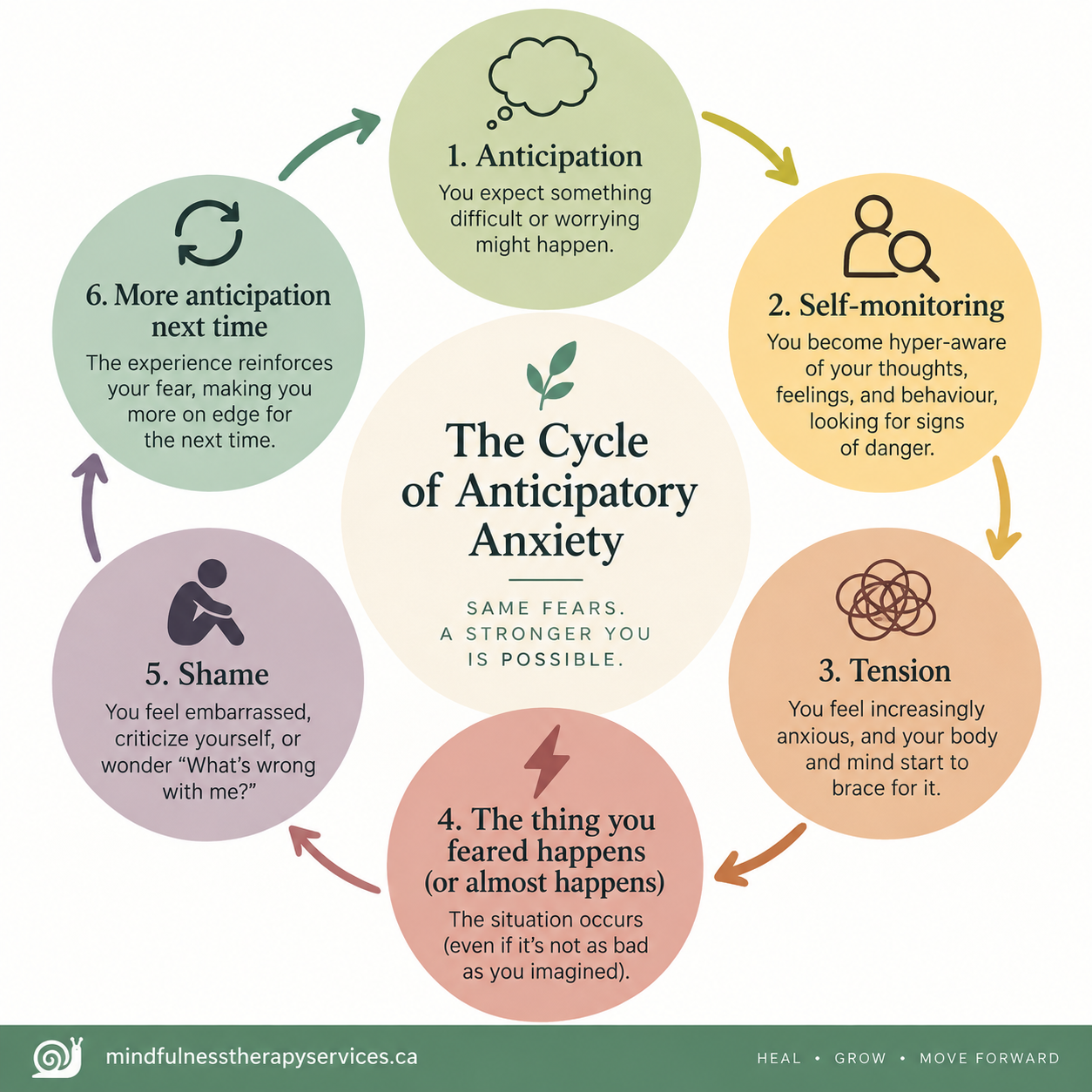
Here’s how to interrupt it:
1. Name it. When you notice the mental sportscaster warming up, label it: “Oh, hi anxiety. You’re early.” Labelling creates a little distance between you and the feeling — and distance is where your power comes back.
2. Change the goal. Instead of aiming for “successful sex,” aim for pleasure. Touch, explore, laugh, enjoy. This is the philosophy behind sensate focus, the famous homework assignment developed by Masters and Johnson: couples take intercourse completely off the table and simply rediscover touch without a destination. Turns out, taking the pressure off is the whole point.
3. Breathe out slowly. A long, slow exhale activates your parasympathetic nervous system — the “rest and digest” mode that arousal actually needs. One or two extended exhales can quietly tell your body it’s safe.
4. Tell your partner. It feels terrifying, but saying “I’m feeling a bit nervous” out loud usually shrinks the secret. Partners are almost always more understanding than our shame predicts, and hiding it only feeds the cycle.
5. Practise self-compassion. Researcher Kristin Neff‘s work shows that self-compassion — treating yourself the way you’d treat a friend — reduces shame and rumination. Next time things don’t go as planned, try: “That was disappointing, and it’s okay. This doesn’t define me.”
6. Train your attention outside the bedroom. Mindfulness is a muscle. Ten minutes a day of noticing when your mind wanders and gently bringing it back (no judgement) makes you better at doing exactly that during sex. Conveniently, that’s what this clinic is all about.
7. Look at what’s fuelling it. Exhaustion, stress, alcohol, medication side effects, unresolved relationship tension, and a steady diet of unrealistic porn expectations can all pile fuel on the fire. Sometimes the bravest move is fixing your sleep before you fix your sex life.
When to reach out for help
If performance anxiety has been hanging around for a while, or it’s starting to make you avoid intimacy altogether, that’s a very reasonable moment to talk to a professional. Sex therapy is practical, shame-free, and remarkably effective, and anxiety-driven difficulties like erectile issues and premature ejaculation respond particularly well.
Our sex therapy sessions combine evidence-based approaches with — you guessed it — down-to-earth mindfulness. Because sometimes the most radical thing you can do in bed is stop performing and start showing up. Our team member, Jennifer Gratzfeld, MSW, RSW, brings an eclectic, trauma-informed, relational approach to sex therapy, often infused with warmth, curiosity, and playfulness.
We are equally committed to supporting friends, partners, and family members navigating relationship challenges within 2SLGBTQIA+ communities. Our work is grounded in compassion, openness, inclusivity, and the belief that healing and connection grow best in judgment-free spaces.
Contact us for a free consultation or book an appointment.
This blog is for educational purposes and is not a substitute for individual assessment or advice from a qualified healthcare professional.
Further reading (while you grab a cup of tea)
– Masters, W. H., & Johnson, V. E. (1970). *Human Sexual Inadequacy*
– Kaplan, H. S. (1974). *The New Sex Therapy*
– Nagoski, E. (2015). *Come as You Are*
– Brotto, L. (2018). *Better Sex Through Mindfulness*
– McCarthy, B., & McCarthy, E. (2003). *Rekindling Desire*