

Content note
This post talks about sexual violence and its effects, including mental health impacts. Please take care of yourself as you read. If you need immediate support, SAVIS of Halton’s crisis line is answered 24/7 at 905-875-1555, or call/text 9-8-8.
You are not alone
Recent headlines, including the case connected to Cornell University that many of you have been following, have brought sexual violence back into sharp, painful focus.
Watching a case unfold publicly can reopen wounds. Memories resurface. Anxiety spikes. Sleep gets harder. Old feelings of fear, shame, and anger come rushing back. If that’s happening for you right now, please know this: you are not alone, and what you’re feeling makes sense.
This post is for survivors of sexual violence, and for the people who love them. We write from a feminist, 2SLGBTQ+-affirming, survivor-centred perspective, and we ground what we share in research. Our goal is simple: to help you understand what trauma does, to validate what you’re carrying, and to point you toward real support in Halton Region. You deserve to be believed, and you deserve care.
Before we begin, one note on language. Some people who have experienced sexual violence call themselves survivors; others prefer victim; many use both at different times. Neither is wrong. Use whatever fits how you feel today.
What trauma does to the body and brain
Sexual assault is a violation of the body, the mind, and the sense of self. It is an act of power and control that hijacks the nervous system. When the brain registers a threat it cannot escape, the body shifts into survival mode: fight, flight, freeze, or fawn. Many survivors freeze, meaning that the body’s automatic, involuntary response when fighting or fleeing isn’t possible. Freezing is not consent, and it is not weakness. It is biology.
Foundational trauma research, from psychiatrist Judith Herman’s work on recovery to Stephen Porges’s polyvagal theory, shows that trauma lives in the body as much as the mind. After an assault, the alarm system can stay switched on. The brain keeps scanning for danger even when the danger has passed. This isn’t a character flaw; it’s a survival adaptation that has outlived its usefulness.
How trauma shows up in daily life
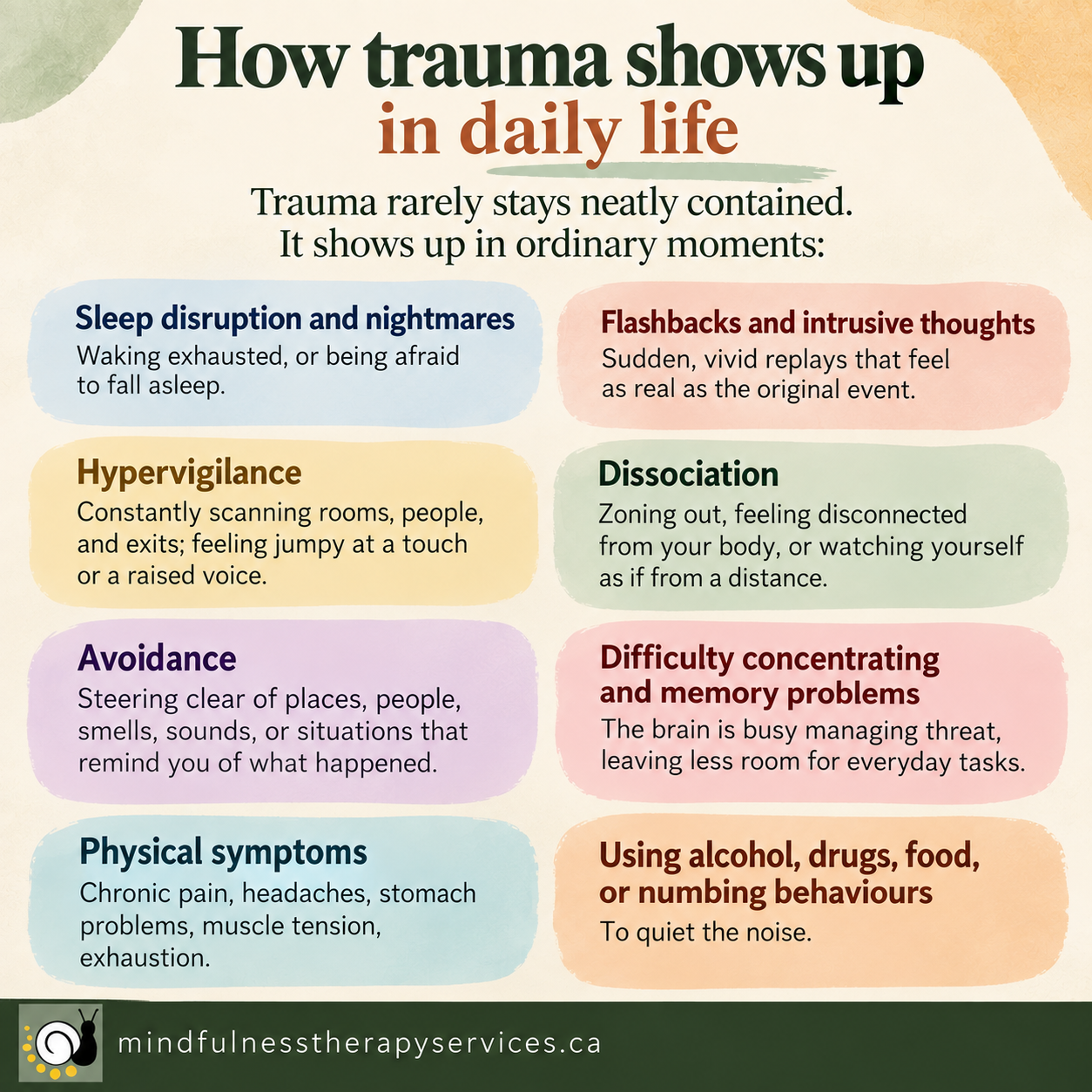
Trauma rarely stays neatly contained. It shows up in ordinary moments:
– Sleep disruption and nightmares, waking exhausted, or being afraid to fall asleep
– Flashbacks and intrusive thoughts: sudden, vivid replays that feel as real as the original event
– Hypervigilance: constantly scanning rooms, people, and exits; feeling jumpy at a touch or a raised voice
– Dissociation: zoning out, feeling disconnected from your body, or watching yourself as if from a distance
– Avoidance: steering clear of places, people, smells, sounds, or situations that remind you of what happened
– Difficulty concentrating and memory problems: the brain is busy managing threat, leaving less room for everyday tasks
– Physical symptoms: chronic pain, headaches, stomach problems, muscle tension, exhaustion
– Using alcohol, drugs, food, or numbing behaviours to quiet the noise
None of this means you’re psychologically damaged or broken. These are the predictable, human responses to an overwhelming event.
Changes to your sense of self
Many survivors describe feeling like a different person after the assault. The question “Who am I now?” sits heavily alongside the shock of “How did this happen to me?”
Self-blame is one of the most common and most painful injuries. Survivors replay the moment obsessively: “Why did I go there? Why didn’t I leave? Why didn’t I fight? Why did I get drunk?” These questions are a cruel trick of the mind. They try to find a version of the story where you had control, because the truth- that someone hurt you without cause is unbearable. But the responsibility belongs entirely to the person who chose to harm you. Not to your outfit, your drinking, your location, or your trust.
Shame compounds this. Guilt says I did something wrong. Shame says I am wrong.
After sexual violence, shame whispers that you’re dirty, damaged, or somehow deserving of what happened. Researcher Brené Brown describes shame as the fear of disconnection; the belief that if people truly knew you, they wouldn’t accept you. Shame thrives in silence and secrecy. It loses power when you say it aloud to someone who responds with compassion.
Relationships, trust, and safety
The vast majority of survivors are assaulted by someone they know: a partner, friend, family member, colleague, or acquaintance. When the person who hurt you is someone you trusted, the betrayal cuts deeper.
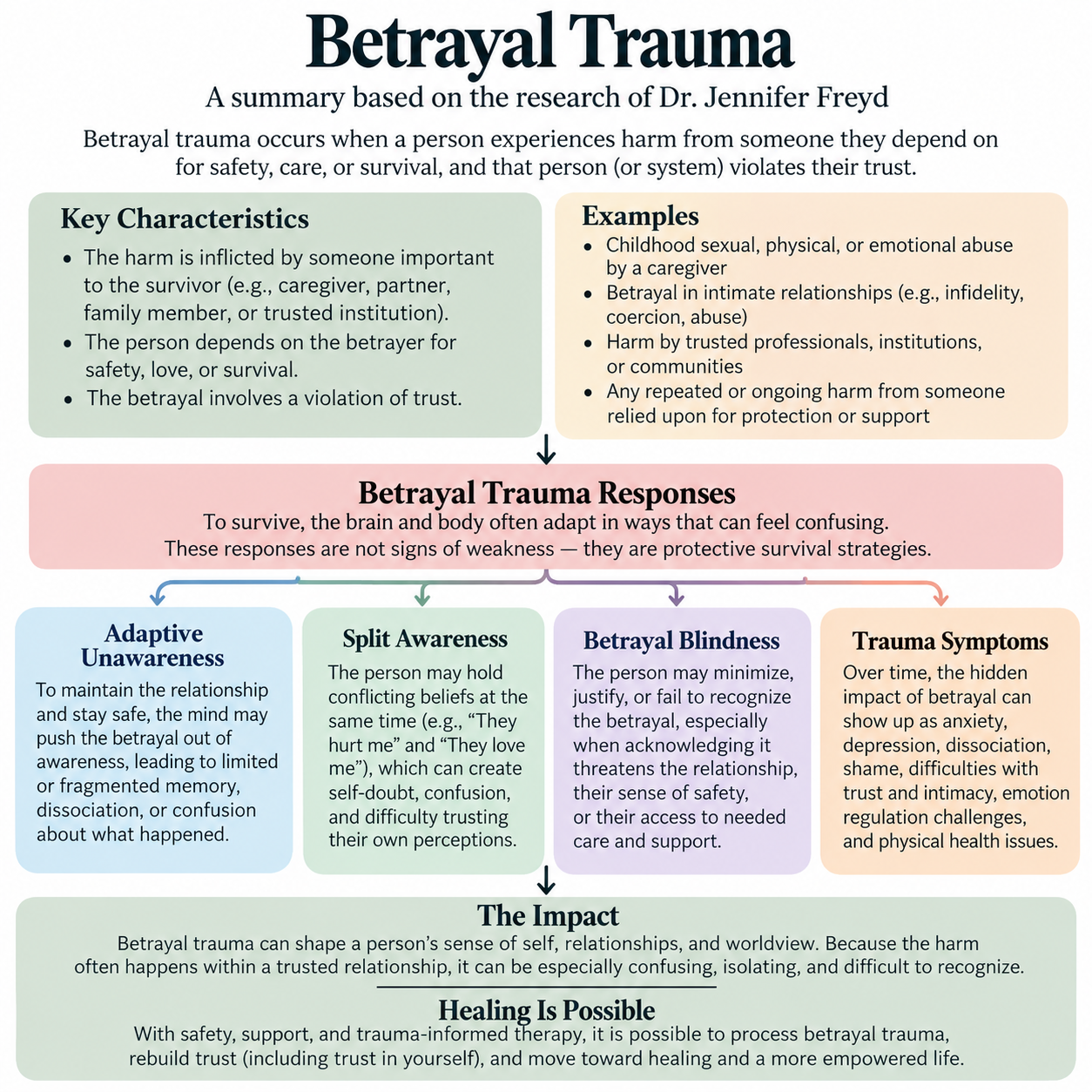
Psychologist Jennifer Freyd’s betrayal trauma theory explains why: when harm comes from someone we depend on, the mind may blur or suppress the memory in order to survive the relationship. The body remembers even when the conscious mind struggles to.
Trust is one of the first casualties of sexual violence.
It can feel impossible to know who is safe. Relationships that once felt secure may suddenly feel risky:
– Intimacy can feel frightening — physically and emotionally
– Boundaries can blur — some survivors struggle to say no, while others become hypervigilant about controlling every interaction
– Isolation creeps in — pulling away feels safer than risking rejection or disbelief
– Parenting and caregiving can be strained — it’s hard to offer a sense of safety when you’re still rebuilding yourself
Healing happens in relationship, not in isolation. Trust can be rebuilt; slowly, selectively, with people who earn it. But it starts with trusting yourself again: your instincts, your perceptions, your right to set limits.
Myths about sexual assault
Myths are not harmless misunderstandings. They shape whether survivors are believed, whether they report, and how they heal. Here are the most damaging ones, and what the evidence actually says:
Myth: “Real rape is a stranger in a dark alley.”
Fact: Most sexual assaults are committed by someone the survivor knows. An assault by a partner, friend, or family member is just as serious and just as criminal.
Myth: “She was asking for it — look at what she wore / how much she drank / how she flirted.”
Fact: No outfit, amount of alcohol, or behaviour constitutes consent. Consent is freely given, affirmative, ongoing, and can be withdrawn at any time. Someone who is incapacitated cannot legally consent.
Myth: “If she didn’t scream or fight back, it wasn’t assault.”
Fact: Freeze is a common, involuntary trauma response. The absence of resistance is not consent.
Myth: “False allegations are everywhere.”
Fact: Research consistently finds that false reports are rare. The far bigger problem is that most sexual assaults are never reported at all.
Myth: “Men can’t be sexually assaulted.”
Fact: Men and boys are survivors too. This myth keeps them silent, and it ignores the reality that an erection or arousal during an assault is a physiological response, not consent.
Myth: “Partners and spouses can’t rape each other.”
Fact: Marital and partner rape is sexual assault, and it is a crime in Canada. Because it involves a trusted person, it can be especially destabilizing.
Myth: “Only young women get assaulted.”
Fact: Survivors are people of every age, gender, race, class, and ability. Elders, disabled people, and trans people face heightened risk.
Myth: “2SLGBTQ+ people don’t really experience this.”
Fact: Two-spirit, lesbian, gay, bisexual, trans, queer, and other marginalized people experience sexual violence at disproportionate rates. In addition, they face additional barriers to being believed and supported.
Myth: “If you waited to report, you must be lying.”
Fact: Delayed disclosure is the norm. Shame, fear, fragmented memory, and mistrust routinely delay reporting by months or years. Delay is not evidence of falsity.
Myth: “Sex workers can’t be assaulted.”
Fact: Anyone can be sexually assaulted. Occupation never equals consent, and every survivor deserves the same legal protection and care.
Social biases that hurt survivors
Survivors don’t just carry the assault; they carry how the world responds to it. Negative social reactions measurably worsen trauma outcomes. Criminologist Sarah Ullman’s research shows that how people respond to a disclosure matters enormously: supportive, believing responses buffer the harm; dismissive or blaming responses compound it.
Common biases that hurt:
– Victim blaming — scrutinizing a survivor’s choices instead of the perpetrator’s actions
– The “perfect victim” standard — the fiction that a credible survivor is sober, chaste, fought back, reported immediately, and matches a narrow image of innocence. Anyone who deviates — because of gender, race, sexuality, poverty, disability, substance use, or a messy life — is treated as less believable
– Media framing — coverage that puts the survivor on trial, highlights their behaviour, or softens the perpetrator’s responsibility
– Systemic racism and colonialism — Black, Indigenous, and racialized survivors are disproportionately disbelieved, over-surveilled, and underserved. The legacy of colonial violence continues to shape who is heard
– Homophobia and transphobia — 2SLGBTQ+ survivors may face misgendering, dismissal, or the lie that same-sex violence is “less real”
– Ableism — the false assumption that disabled people are asexual, dependent, or unreliable witnesses
– Institutional betrayal — the deep harm caused when schools, workplaces, churches, or police forces that were supposed to protect instead minimize, punish, or cover up
These biases are not the survivor’s fault. They are community failures, and they are part of why so many survivors stay silent.
The right to choose your path
Let’s be absolutely clear: your story belongs to you.
Disclosure is a choice, not an obligation. You get to decide whether to tell anyone, who to tell, how much to share, and when. Choosing not to tell anyone is not cowardice is agency. Telling one trusted friend is enough. Going public is never required for healing.
Reporting to the police is also a choice, one option among many, not a test of whether your experience “counts.” Some survivors report and find justice; others report and are retraumatized by the process; many never report and still heal deeply. All of these are legitimate paths. Not reporting doesn’t mean you’re hiding the truth. It means you made the best decision you could for your own safety and wellbeing, and you can change your mind at any time.
Healing does not require making your pain legible to institutions. It requires reclaiming your own sense of agency, one choice at a time.
What helps: recovery and coping tools
Recovery is real, and it is possible. It is also rarely linear. Please expect ups and downs, and know that a difficult week is not a sign of failure. There is no timeline for healing, and healing is not the same as forgetting.
Several research-based therapies that can help. Trauma-focused therapies have strong research support. Somatic and body-based approaches can help release trauma held in the body. Group therapy and peer support reduce the isolating feeling of “no one understands.” If you’re looking for a therapist, ask about trauma training and fit.
Remember that the relationship matters as much as the method.
Grounding tools.
When you feel flooded, grounding brings you back to the present:
- The 5-4-3-2-1 exercise: name 5 things you can see, 4 you can touch, 3 you can hear, 2 you can smell, 1 you can taste
- Slow breathing: inhale for four counts, hold for four, exhale for six.
- Temperature shift: splash cold water on your face or hold ice — it can interrupt a spiral
- Orienting: look around the room and name objects aloud, reminding yourself where you are and that you are safe now
- Movement and the body. Gentle movement — walking, stretching, yoga, dancing — can help you feel at home in your body again. Start small and go at your own pace; forced exercise is not the goal.
- Self-compassion. Talk to yourself the way you’d talk to a beloved friend. Notice the inner critic and gently push back. Write down what you wish someone had said to you, and say it to yourself.
- Connection. Isolation feeds shame. Reach out — to one trusted person, a support group, or a counsellor. You don’t have to tell your whole story to receive care.
- Practical stability. Routines, sleep, nourishment, and reducing reliance on numbing substances all rebuild the foundation that trauma shakes. And give yourself permission to say no to things that drain you.
- Advocacy and information. Knowing your rights restores a sense of power. Ask questions. Bring a support person to appointments. You are allowed to take up space.
Questions & Answers
Thinking about reporting to the police?
Deciding whether to report is deeply personal. Here are answers to the questions survivors most often ask. Please note that this is general information, not legal advice — an advocate or lawyer can help with your specific situation.
Do I have to report?
No. Reporting is your choice, and it never reflects whether your experience was real. You can seek counselling, medical care, and support without ever contacting police.
Is there a time limit?
In Canada, there is no time limit on reporting a sexual assault to police. However, if you want a forensic exam (a sexual assault evidence kit, sometimes called a SAECK), it is best done soon after the assault — ideally within 72 hours — to preserve DNA evidence. Even if you’re unsure about reporting, a hospital can collect evidence so the option stays open. If you’ve already washed or changed clothes, that’s okay — it doesn’t erase your experience, and evidence can still matter.
What happens when I report?
An officer will take your statement, and you may be offered a forensic exam. Police will investigate, and the Crown prosecutor decides whether charges proceed. The process can take months or years. You have the right to be kept informed, and you can ask about victim services at any stage.
Will I be believed?
You deserve to be believed. Officers have a duty to investigate sexual assault seriously. If you feel dismissed or blamed, you can ask to speak with a supervisor, and you can bring an advocate from SAVIS of Halton with you for support.
What if I don’t remember everything?
Memory fragmentation is common after trauma — dissociation can blur details. Tell the officer what you do remember. Gaps in memory do not invalidate your account, and in law, corroboration is not required for a sexual assault conviction.
What if I had been drinking or using drugs?
Being intoxicated does not mean you consented. Under Canadian law, someone who is incapacitated cannot legally consent. The focus belongs on the perpetrator’s actions, not on what you consumed.
Will my name be public?
In Canada, there is a publication ban protecting the identity of complainants in sexual assault proceedings. The court process protects your privacy.
Can I bring a support person?
Yes — you can ask to have a support person with you, and advocates from agencies like SAVIS can accompany you through the process.
What if the person who hurt me is my partner or family member?
It is still a crime, and you can still report. Because the risk of ongoing harm may be higher, safety planning is especially important. Ask victim services about safety options, housing, and protective measures.
Can I change my mind after reporting?
You can tell police you don’t want to proceed, and they will take your wishes seriously. Ultimately, the Crown prosecutor decides whether charges continue, but an advocate can explain the process and help you make an informed decision at every step.
What if I’m worried about my immigration status?
You have the right to police services regardless of immigration status, and police in Canada are not immigration officers. If you have concerns, a community legal clinic or an advocate can help you understand your situation before you decide anything.
What if I’m 2SLGBTQ+ and afraid of discrimination?
You deserve respectful, affirming treatment. You can request an officer you feel comfortable with, and SAVIS serves survivors of all genders and sexualities. If you experience discrimination, you can make a complaint, and an advocate can support you.
Support in Halton Region
If you’re in Halton Region and need support, these services are free and confidential:
– SAVIS of Halton (Sexual Assault and Violence Intervention Services) — 24/7 crisis line: **905-875-1555**; office/enquiries: **905-825-3622**
– Free, confidential crisis counselling and up to 12 one-on-one counselling sessions for Halton residents, open to women, men, trans, and gender-diverse survivors aged 16+
– HVPC— crisis line: 1-877-825-9011**; free walk-in counselling;
– Halton Regional Police Service — sexual assault resources and reporting information: (call **911** in an emergency
– 211 Ontario— free, confidential referral line answered by real people 24/7: dial **2-1-1** or call toll-free **1-888-364-1210**
– Kids Help Phone — for young people under 21: **1-800-668-6868**, 24/7, call or text
– 9-8-8 Suicide Crisis Helpline — call or text **9-8-8**, 24/7, bilingual
A closing word
If you’re reading this because you’re struggling, please hear this: what happened to you was never your fault, and you are not alone. Healing isn’t about becoming the person you were before—it’s about building a life that honours what you survived and what you still want. You get to decide what that looks like.
And if today is hard, reach out. The SAVIS crisis line is answered every hour of every day at **905-875-1555**by people who will listen without judgement. You don’t have to carry this alone.
If this post helped you feel less alone, please share it with someone who needs it.
And if you have questions about our team or our therapy services, reach out to
book a therapy session or a free consultation