


Why You Can’t Just ‘Get Over It’: Trauma and Your Nervous System
Have you ever snapped at someone you love over something small, and then felt confused about your own reaction? Or sat in a meeting feeling strangely foggy and far away, like you were watching yourself from behind glass? Or felt your whole body go rigid when a car honked, long after the moment had passed?
If any of that sounds familiar, I want you to hear this clearly: there is nothing wrong with you. Your body is doing exactly what it learned to do to keep you safe.
Why “Just Get Over It” Doesn’t Work
Trauma isn’t only a story we carry in our minds. It’s a pattern that gets encoded in the body, particularly in the nervous system, the network that’s constantly, silently scanning for safety or danger, whether or not we’re consciously aware of it.
A lot of the clinical understanding of this comes from polyvagal theory, developed by researcher Stephen Porges. Though it’s a theory, not a therapy modality. And even when it remains somewhat controversial, it has some positive impact on the practice in the therapy room. The theory describes how our autonomic nervous system moves between a handful of states: a calm, socially connected state; a mobilized fight-or-flight state; and, when neither of those feels possible, a shutdown or freeze state.
Trauma can bias the nervous system toward the defensive states, even long after the danger has passed, making safe situations feel unsafe.
This is also why willpower alone rarely resolves trauma symptoms. You’re not choosing to overreact to a slammed door or a certain tone of voice; your nervous system is pattern-matching to old danger faster than your thinking brain can weigh in.
What Dysregulation Can Actually Look Like
Nervous system dysregulation shows up differently for different people. A few examples:
- The parent who snaps. After a long day, a child’s whining tips a parent from calm straight into rage, not because they don’t love their child, but because their sympathetic nervous system was already primed from an earlier stressor.
- The employee who goes blank. Asked a simple question in a meeting, someone freezes and can’t find a single word, even though they know the material cold. That’s a dorsal vagal shutdown response, not a knowledge gap.
- The partner who withdraws. During a disagreement, one partner goes quiet and emotionally unreachable, not out of indifference, but because conflict once meant danger, and their body has learned to disappear rather than engage.
None of these are character flaws. They’re a nervous system doing what it was shaped to do.
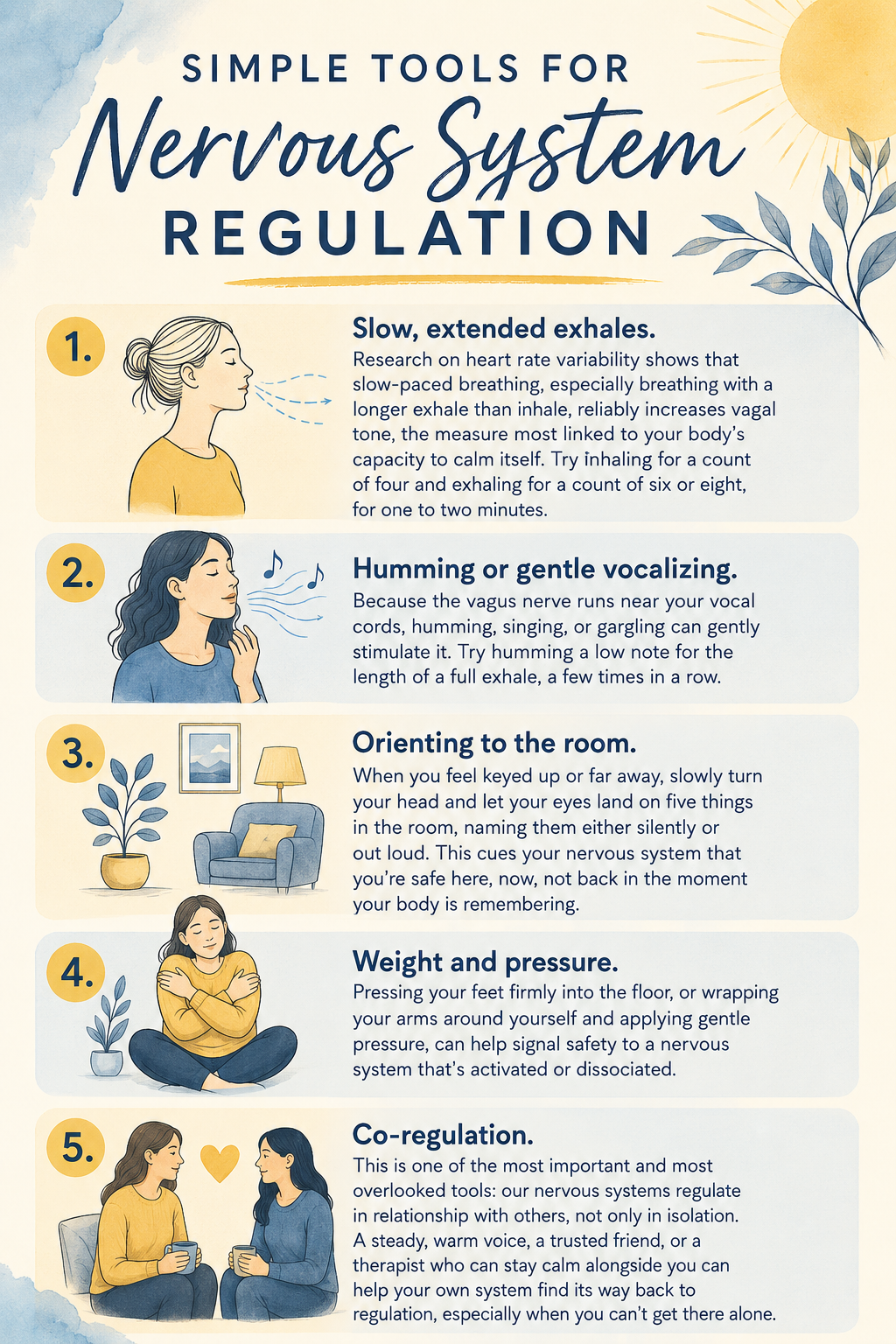
Simple Tools for Nervous System Regulation
The encouraging part of this research is that the nervous system is changeable, often described as “neuroception,” recalibrating over time with the right, repeated experiences of safety. Here are a few accessible starting points.
This Takes Time. And You Don’t Have to Do It Alone
None of these tools are a substitute for deeper trauma work, and they’re not meant to be. Think of them as first-aid for your nervous system in the moment: small, physical interventions that can create just enough space to think, breathe, and choose your next step.
If you recognize yourself in any of this: the snapping, the shutting down, the feeling of being on guard even when nothing is technically wrong, please know that this is deeply treatable. Trauma-informed therapy, including approaches like Mindfulness, ACT, CBT and somatic work, is specifically designed to help your nervous system learn, slowly and safely, that it doesn’t have to stay braced for danger that has already passed.
Ready to explore what nervous system-informed trauma therapy could look like for you? Book a free consultation with Mindfulness Therapy Services today.