


Image is ai generated
Why Finding a Gender-Affirming Therapist Is So Hard, And How to Make It Easier
Let’s be honest: therapist-hunting is kind of complicated. You’re already dealing with stuff; that’s why you’re looking for a therapist, and now you have to wade through a sea of bland profile photos and vague bios that all say “I use a client-centred approach” without actually telling you anything useful.
And if you’re trans, non-binary, gender-diverse, or somewhere in the glorious, expansive middle of figuring it all out? The stakes feel even higher.
Because the last thing you need is to finally work up the nerve to open up in a therapy session… only to spend the first 20 minutes explaining what “non-binary ” is.
You deserve better than that. A lot better.
The Questions Running Through Your Head -We’ve Heard Them All
“Will this therapist actually get it?”
“What if they say something well-meaning but completely off-base and I have to decide whether to correct them or just smile and dissociate?”
“Will I feel safe enough to actually be honest?”
These aren’t picky questions. They’re completely reasonable ones. Therapy only works when you feel genuinely safe. Which means, not performing safely, not politely tolerating the awkwardness safely, but actually, deeply safe.
So let’s talk about what to look for.
What Is Gender-Affirming Therapy, Actually?
Here’s what it’s not: a therapist who spends your sessions side-eyeing your identity or gently suggesting you “explore all possibilities” in a way that feels less like curiosity and more like doubt.
Gender-affirming therapy means your therapist starts from the position that your gender identity is valid. Full stop. No asterisks, no “but have you considered—”, no conversion-lite nonsense dressed up in clinical language.
What they do instead is create space for you to explore your identity, your questions, your feelings, your life. All this, done at your own pace, in your own way. Maybe you know exactly who you are and just need support navigating a world that doesn’t always make it easy. Maybe you’re in the middle of figuring things out and want somewhere to think out loud without feeling like you’re being watched for the “right” answer.
Either way, you get to lead. They’re just there to help you think.
And yes, research backs this up, affirming that environments are genuinely linked to better mental health outcomes for trans and gender-diverse people. Feeling seen isn’t a luxury. It’s actually kind of essential.
Why This Stuff Matters. And Why We’re Not Going to Sugarcoat It
Many gender-diverse people carry a lot. Discrimination, rejection from family or friends, microaggressions at work or school, and healthcare experiences that ranged from “unhelpful” to outright harmful. The mental load of navigating a world that wasn’t exactly designed with you in mind is real and heavy.
There’s even a psychological framework for it called the minority stress model, which essentially says: yes, chronic experiences of stigma take a toll on mental health. Shocking to no one who has lived it.
The flip side?
Supportive relationships and affirming care genuinely protect mental health. Feeling understood matters. Having one person in your corner who just gets it can make a big difference.
That’s what good therapy can be.
Meet Jennifer, Your Therapist Who Actually Gets It
At Margarita Rabinovich, RP & Associates in Burlington, Ontario, Jennifer Gratzfeld, MSW, RSW, has spent nearly two decades working with adolescents and adults navigating identity, gender diversity, sexuality, relationships, trauma, and all the complicated, messy, beautiful stuff that comes with being human.
She’s warm. She’s down-to-earth. She has a sense of humour. And she’s genuinely, deeply committed to creating a space where you can show up exactly as you are — questions, uncertainties, contradictions, and all — without having to perform a tidier version of yourself for anyone’s comfort.
Jennifer works with folks across the 2SLGBTQIA+ community, including people exploring gender identity, sexual orientation, ethical non-monogamy, and relationship diversity. She’s sex-positive, gender-affirming, and she’s not going to make you feel like a case study.
Clients often say the most healing part of therapy with Jennifer is finally being able to talk without having to carefully measure every word. Imagine that! A full hour where you’re not editing yourself. It’s kind of radical.
Jennifer offers virtual therapy across Ontario, so wherever you are in the province, you can access support from your couch, your car, or wherever you feel most yourself.
Signs You’ve Found a Therapist that Feels Right
Here are some things that show you that a gender-affirming therapist has done the work:
They ask instead of assuming. A good therapist will ask what pronouns you use, what terms feel right to you, and how you’d like them to refer to your identity. Not in a checkbox-y, HR-department way, but because they genuinely want to get it right.
They keep learning. Gender diversity isn’t new, but our collective understanding keeps evolving. A good therapist stays curious by reading current research, following updated WPATH and CPATH guidelines, and keeping up with what’s actually happening for LGBTQIA+ communities. They don’t need to know everything. They just need to be genuinely interested in knowing more.
They don’t make everything about gender. Here’s a refreshing one: sometimes you want to talk about your anxiety, or your job, or the fact that your family is driving you absolutely bananas. A skilled affirming therapist knows that being gender-diverse is part of your life and not the explanation for every single thing in it. You’re a whole person, not a thematic through-line.
They understand intersectionality. Your identity isn’t just one thing. Race, culture, religion, disability, neurodiversity, immigration, and family dynamics. All of these shape your experiences in ways that interact and overlap. A good therapist gets that and meets you in the full complexity of who you are.
Questions Worth Asking Before You Book
Most therapists offer a free consultation, including us. Think of it like a first date, except you’re allowed to ask direct questions and nobody has to pretend to like the same movies or food.
Try asking:
- What experience do you have working with transgender and non-binary clients?
- How do you approach gender exploration in therapy?
- Have you completed any training in gender-affirming care?
- How do you support families of gender-diverse youth?
You are completely allowed to interview your therapist. In fact, please do. A good therapist will welcome it. We love it! It shows us you are committed.
For the Parents in the Room
If you’re a parent reading this because your kid just told you something important and you’re trying to figure out what to do next, firstly, the fact that you’re here says a lot. You’re showing up. That matters.
You might be feeling confident and informed. You might be feeling overwhelmed, scared of saying the wrong thing, or quietly grieving something you thought you understood about your child’s future. All of that is okay. Parenting a gender-diverse kid is a learning curve, and nobody expects you to nail it on day one.
Here’s what the research actually shows: family support is one of the most powerful protective factors for trans and gender-diverse youth. You don’t have to have all the answers. You just have to stay connected and keep trying.
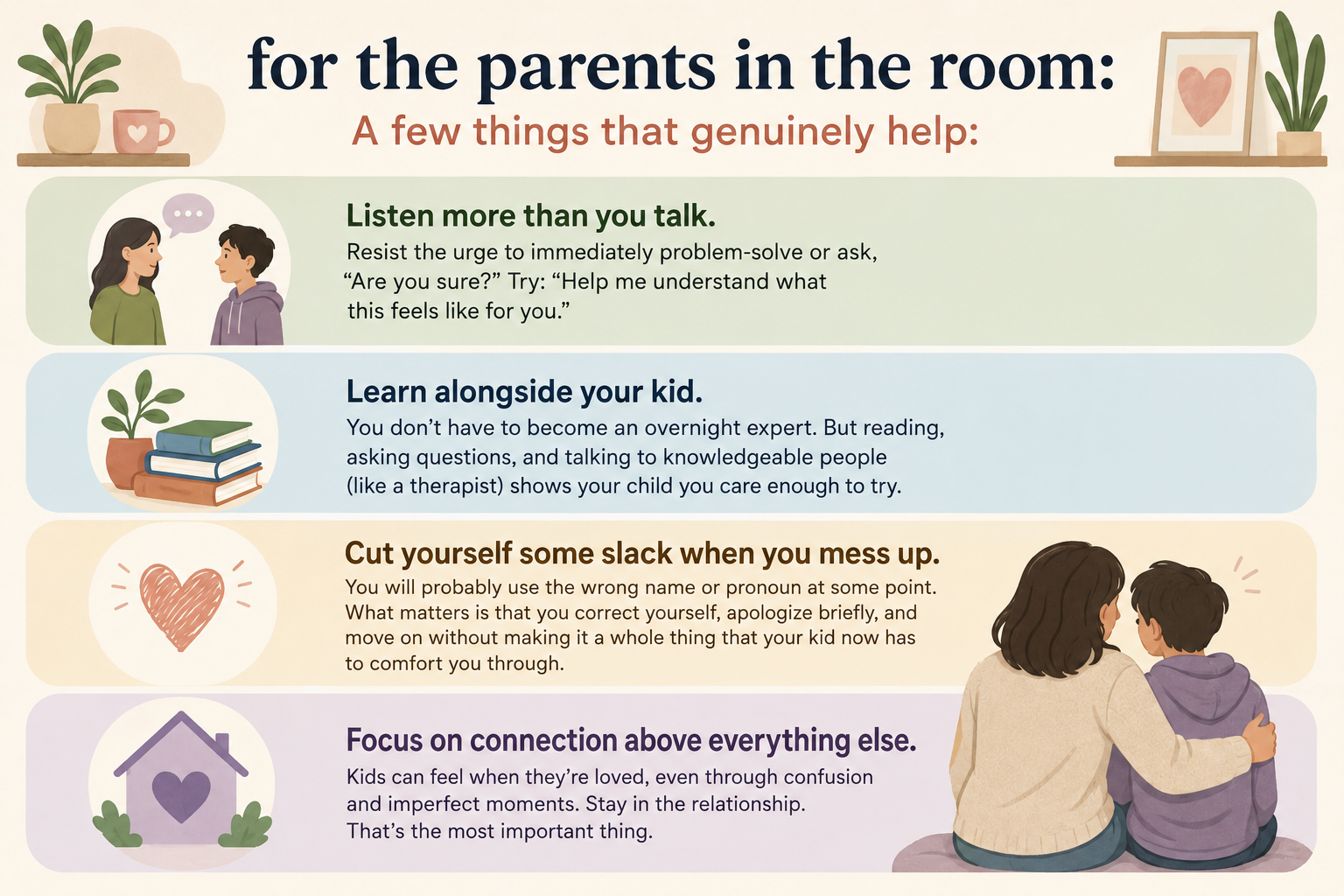
Support Means The World
Why People Come to See Us
People come to therapy for all kinds of reasons:
Exploring gender identity. Coming out again, or for the first time, or to one specific person who makes it complicated. Exploring who you feel safe to let into your experience. Managing anxiety or depression. Processing discrimination or trauma. Working through family conflict. Building self-confidence and self-agency. Figuring out relationships. Or just needing somewhere to think out loud with someone who isn’t going to judge you.
Whatever brings you here, you don’t have to justify it or make it sound important enough. It’s important because you’re important.
Q & A: A Few Questions We Get Asked a Lot
Do I have to be trans to see a gender-affirming therapist? Nope. Lots of people seek out affirming therapists simply because they want an inclusive, non-judgmental space, regardless of their gender identity.
What if I’m still figuring things out? That’s literally what therapy is for. You don’t need to have it all sorted before you start.
Can my parents come to therapy too? Yes! We work with parents, caregivers, and families who want to show up better for their gender-diverse loved ones.
Will the therapist tell me what my gender is? Absolutely not. Ethical therapists don’t decide your identity for you. They help you explore and discover what’s already there.
You Deserve a Space Where You Can Just… Breathe
Finding a therapist who truly affirms who you are isn’t just a nice-to-have. It can be genuinely life-changing.
You deserve a space where you can stop monitoring yourself, stop pre-editing your words, and just actually talk. About what’s hard. About what you’re figuring out. About what you need.
If you’re wondering whether therapy might be a good fit for you, your teen, your family, or your relationship, we’d love to hear from you. You can book a free consultation, and we promise it’s a genuinely low-pressure conversation.
Come as you are. Seriously! All of you are welcome here.
Connecting is your first step: